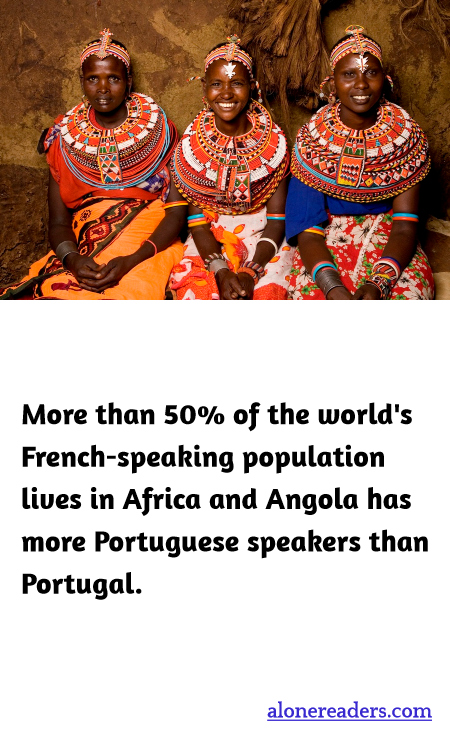
The linguistic landscape of the world is constantly evolving, and one of the most fascinating aspects of this evolution is the shift in the global distribution of language speakers. Notably, more than half of the world's French-speaking population now resides in Africa. This is a significant statistic considering that French has been a prominent European language with roots deeply embedded in the history of France. However, the expansion of French in Africa can be traced back to the colonial period when French was imposed as a lingua franca. Today, countries such as the Democratic Republic of the Congo, Côte d'Ivoire, and Senegal are among those with a rapidly growing number of French speakers. The widespread use of French across various African nations underscores not only the colonial past but also the adaptation and integration of the language into African cultures.
Meanwhile, the Portuguese language presents a similar narrative in Angola. Surprisingly, Angola has more Portuguese speakers than Portugal itself. This phenomenon results from Angola's history as a Portuguese colony until its independence in 1975. Over the decades, Portuguese has remained the official language and a primary medium of education and administration. In Angola, the prevalent use of Portuguese illustrates how colonial languages can become ingrained in the societal fabric of a nation and continue to wield influence long after the end of colonial rule.
These linguistic dynamics highlight broader themes of globalization, cultural integration, and the legacy of colonialism. The dominance of European languages in Africa points to a complex confluence of history, identity, and power. However, it also showcases the adaptability of language and how it can serve as a bridge among diverse people. As countries like those in Africa continue to grow and develop, the role of languages like French and Portuguese will be interesting to observe, especially in terms of educational policies, international relations, and cultural exchanges. The future of these languages in Africa could redefine linguistic boundaries and influence global language trends for years to come.
