More About This Card
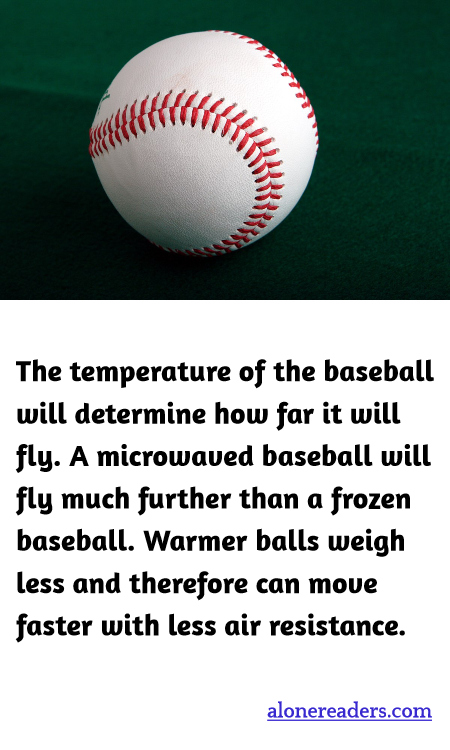
The impact of temperature on the distance a baseball travels is a fascinating aspect of physics that plays a significant role in the game. When a baseball is heated, such as by microwaving it, the molecules inside the ball start moving more rapidly. This increased molecular motion causes the ball to expand slightly and become more elastic. When hit, a warmer, more elastic baseball compresses and then rebounds more forcefully off the bat, resulting in a longer flight distance.
Conversely, cooling a baseball, for example by freezing it, produces the opposite effect. The molecules within the ball slow down, leading to a decrease in the ball's elasticity. A colder, less elastic ball does not compress as much upon impact and therefore does not rebound as forcefully, resulting in shorter flight distances. Additionally, the density of a colder baseball increases, making it heavier and more subject to the force of gravity, which further reduces its flight distance.
The idea that warmer balls weigh less is a misconception. The mass of the ball does not change with temperature; however, the increase in volume due to thermal expansion may give the impression of a reduced weight. Additionally, air resistance plays a role but operates differently; it is the ball's speed, spin, and surface character altered by temperature, rather than changes in weight, that mainly influence its interaction with air resistance.
Therefore, the initial increased speed of a warmer baseball and its more elastic nature contributes to its ability to travel further. While the concept of using microwaved baseballs is not practical or allowed in regulated sports, understanding the effect of temperature on baseball mechanics can help players and coaches strategize around equipment care and game-time decisions, particularly in varying weather conditions. Hence, the thermodynamics of a baseball significantly influences its performance and is an essential element of the physics in sports.