More About This Card
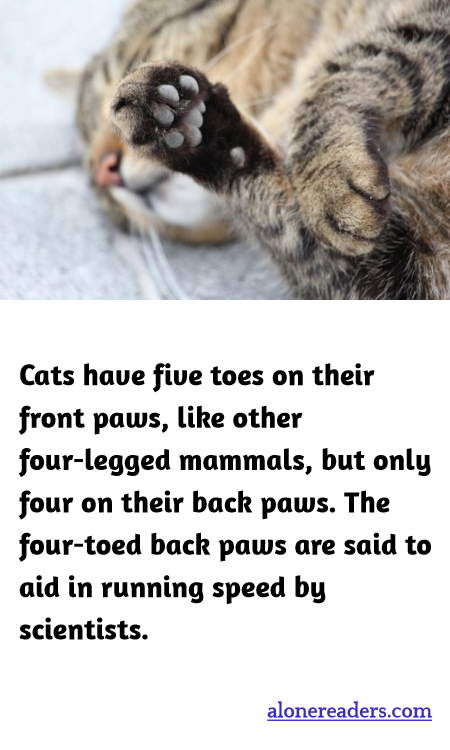
Cats, known for their agility and grace, possess a unique physical trait that contributes to their exceptional locomotive abilities. While like most four-legged mammals, cats have five toes on each of their front paws, it's their hind paws that often capture attention with only four toes. This anatomical feature is not just a random variant but serves a significant purpose in enhancing their overall performance in movement—especially in running.
The structure of a cat's back paws, having one less toe compared to the front, is believed by scientists to aid in their running speed. The reduced number of toes on the rear paws results in a lighter foot, enabling quicker and more efficient motion. This subtle evolutionary adaptation allows the rear paws to spend less time on the ground, facilitating a faster lift-off and hence, superior acceleration. This is crucial for a predator that relies on the element of surprise and quick bursts of speed to catch its prey.
Furthermore, the cat's paws are also evolutionarily optimized for silent stalking, another critical aspect of their hunting strategy. The pads of their paws are soft, allowing cats to move silently and unnoticed. This stealth is augmented by their sharp, retractable claws, which when not in use, are sheathed to further muffle any sounds and prevent premature wear, only extended for climbing or during an attack.
The combination of these physical traits — speed optimization through toe count difference between front and back paws, the ability to move silently due to their padded paws, and the strategic use of sharp claws — make cats formidable hunters. Their design is a perfect marriage of form and function, a refined product of millions of years of evolution. It's these attributes that not only make them adept predators but also fascinating subjects of study in the fields of biology and animal physiology. As pets, these same traits translate to the playful pounces and endearing stealth typical in domestic play, adding to our fascination and enjoyment of these beloved animals.