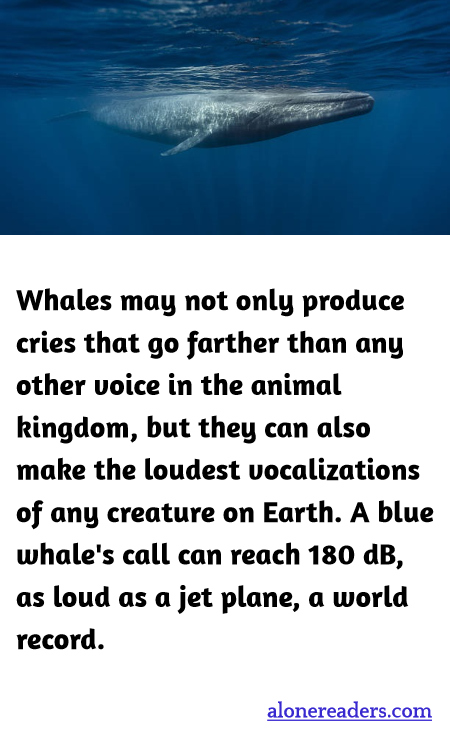
Whales, the gentle giants of the ocean, are not just remarkable for their immense size but also for their extraordinary vocal abilities. Among the various types, the blue whale holds the record not only for being the largest animal on Earth but also for producing the loudest sounds ever recorded from a living creature. These magnificent marine mammals emit calls that can reach up to 180 decibels, a level comparable to the noise produced by a jet plane during takeoff. This incredible volume allows their calls to travel hundreds of miles underwater, enabling communication over vast oceanic distances.
The purpose of these vocalizations is multifaceted. Primarily, they are used for communication between individuals, helping them to locate each other across the expansive and often murky oceanic waters. These sounds play a crucial role in their mating rituals, as they can convey information about the individual’s location, size, and reproductive status. Researchers have also suggested that some of the lower frequency sounds may assist in navigation, bouncing off the seafloor and helping these ocean wanderers to orient themselves in the deep waters.
Understanding these vocalizations is not just about marveling at their loudness; it also provides critical insights into the life and behavior of whales. Scientists use hydrophones and other sophisticated underwater recording equipment to study these sounds, helping decipher the complex social structures of whale pods and even aiding in conservation efforts. With many whale species endangered due to habitat destruction, collisions with ships, and climate change, such research is pivotal.
Moreover, studying how sound travels underwater and how whales utilize it has broader implications. It can improve our understanding of underwater acoustics, which has applications in submarine navigation, underwater seismic studies, and even in the development of better communication systems for undersea exploration.
In conclusion, the vocal prowess of whales, particularly the blue whale, is not only a fascinating natural wonder but also a critical area of study that bridges marine biology, environmental conservation, and technological advances in underwater acoustics. The more we learn about these vocalizations, the better equipped we are to protect these majestic creatures and ensure their voices are not silenced by human activities.
