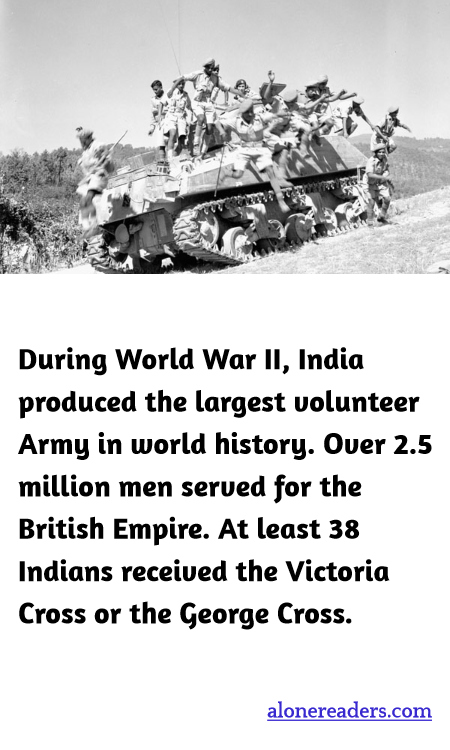
During World War II, India's significant contribution to the Allied forces is vividly illustrated by the formation of the largest volunteer army in world history. Over 2.5 million Indian men enlisted voluntarily, reflecting an extraordinary display of valor and commitment in a time of global upheaval. Serving under the British Empire, these men fought in various theatres of war across Europe, Africa, and Asia, demonstrating remarkable bravery and resilience.
The Indian Army's involvement was crucial in several key campaigns, including the battles in North Africa against Rommel’s Afrika Korps, the Italian Campaigns, and the fight against the Japanese in Burma. Indian soldiers were known for their courage, earning widespread respect and admiration. Their contributions were not just in combat roles; Indian personnel also served in engineering, medical, and logistical capacities, among others, proving instrumental in supporting the war efforts.
Highlighting their heroism, at least 38 Indians were awarded the Victoria Cross or the George Cross—Britain's highest awards for gallantry. These honors are a testament to their bravery and sacrifice, as these soldiers demonstrated exceptional courage in the face of extreme danger. For example, Naik Jadu Nath Singh, an Indian soldier, posthumously received the Victoria Cross for his actions during the Battle of Mandalay in 1945, where he held his ground against overwhelming enemy forces until he was mortally wounded.
However, despite their immense contribution, the role of Indian soldiers in WWII was not widely recognized for many years. Historically, the focus had often been on Western fronts and forces. More recent scholarship and media, however, are bringing deserved attention to these brave individuals. The acknowledgment serves not only to honor those who fought but also helps in understanding the broader scope of India’s role in global historical events.
This shift in recognition also contributes to a more nuanced understanding of the complexities surrounding India’s own history during colonial times. As these soldiers fought under the British flag, India was simultaneously embroiled in its own struggle for independence from British rule. The juxtaposition of these dynamics adds layers to the narrative of India during the Second World War, reflecting broader themes of loyalty, colonialism, and the fight for national sovereignty.
In conclusion, the story of the Indian Army in World War II is a remarkable chapter of both military history and the history of India itself. It embodies themes of courage, sacrifice, and complex political relationships, offering rich insights into the era's global impact and the individual stories of valor and resilience. As more of these stories come to light, the full extent of India’s contribution to the World War II efforts continues to gain clearer focus and greater appreciation worldwide.
