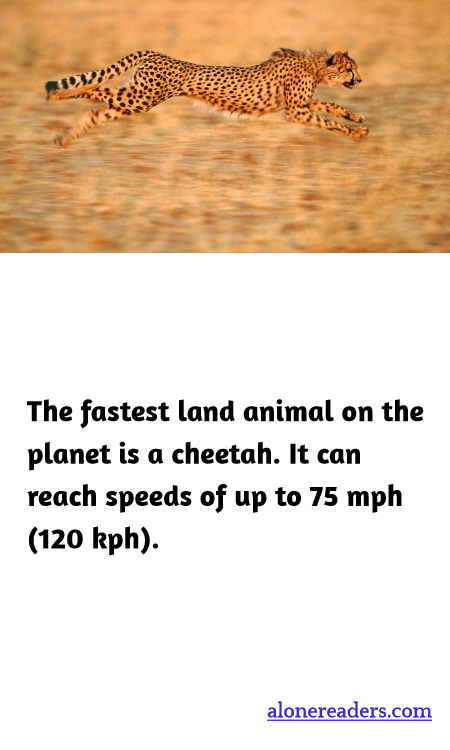
The cheetah, long revered for its speed and agility, holds the title for the fastest land animal on the planet. Remarkably adapted for high-speed pursuits, the cheetah can accelerate from a standstill to speeds up to 75 mph (120 kph) in just a few seconds, achieving top speeds that far exceed those of any other land animal. This incredible ability is essential for the cheetah, as it primarily hunts swift prey such as antelopes, which necessitate such extraordinary bursts of speed.
The cheetah’s anatomical structure is finely tuned for speed. It possesses a lightweight frame, long slender limbs, and a flexible spine that allows it to extend its body significantly while running, thereby increasing its stride length. An enlarged heart and lungs enable the cheetah to circulate oxygen efficiently during a high-speed chase, which is critical for maintaining such intense speeds. Additionally, cheetahs have specialized pads on their feet and semi-retractable claws that provide them better grip and traction during the chase.
Interesting adaptations also include their highly refined sense of vision. Cheetahs have large eyes set forward in their skulls, giving them an exceptional field of view to spot prey from a distance. The feline’s tail acts as a rudder, helping to steer and balance at high speeds, which is particularly crucial when making sharp turns in pursuit of agile prey.
However, the cheetah's remarkable speed comes with limitations. Due to the intense physical demands of their rapid acceleration and high speeds, cheetahs can only maintain these bursts for short distances of up to 300-400 meters. They also run a high risk of overheating, which further limits the duration of their sprints. Post-chase, cheetahs need a considerable amount of time to recover and often remain vulnerable to other predators that might attempt to steal their kill.
Conservation efforts are critical for the survival of cheetahs, whose populations have dwindled due to habitat loss, human-wildlife conflicts, and illegal trafficking. By protecting natural habitats and supporting wildlife conservation initiatives, we can help preserve this extraordinary species for future generations to witness and study its spectacular predatory skills and biological adaptations.
