More About This Card
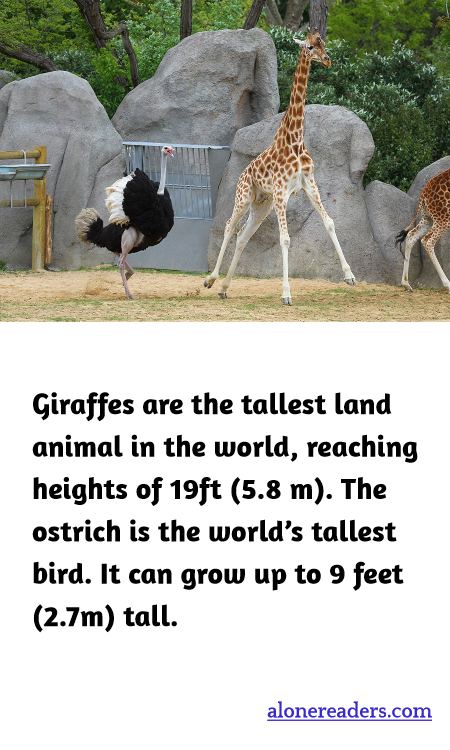
Giraffes and ostriches are among the most fascinating wildlife, notable for their extraordinary heights. Giraffes, holding the title for the tallest land animals on Earth, can reach an astonishing height of up to 19 feet (5.8 meters). These majestic animals roam the savannas and woodlands of Africa where their height offers them numerous survival advantages. Their long necks enable them to reach leaves high up in the trees, primarily feeding on foliage that other herbivores cannot access. This height also provides them with an extensive field of vision, allowing them to be on the lookout for predators from a considerable distance.
Similarly impressive are ostriches, which stand as the world’s tallest birds. An adult ostrich can grow up to 9 feet (2.7 meters) tall. Unlike giraffes, ostriches are flightless, but their long legs allow them to run at speeds of up to about 45 miles per hour, making them the fastest two-legged animals on the planet. These birds are native to the African continent where their height and speed are crucial for survival, helping them to spot predators and escape threats quickly.
Both giraffes and ostriches have adapted well to their environments, despite the challenges posed by their considerable sizes. For giraffes, their unique cardiovascular system manages the blood flow up their long neck to their brains when they bend down to drink, preventing them from fainting. Ostriches, on the other hand, have powerful legs that are not only built for speed but also for formidable defense, with a forward kick from their strong limbs capable of deterring most predators.
In ecosystems where predators abound, the height of giraffes and ostriches provides not just a vantage point but also a means of social interaction and survival. Their impressive sizes allow them to scan vast stretches of land and communicate with each other over long distances, alerting to potential dangers or opportunities for foraging. Despite being so different - one being a mammal and the other a bird - both creatures exhibit how evolutionary adaptations have molded them to not just survive but thrive in their respective habitats. These adaptations remind us of the intricate ways in which different species have evolved over millennia to occupy unique niches in their environments, each with a set of traits perfectly suited to their lifestyle and needs.