More About This Card
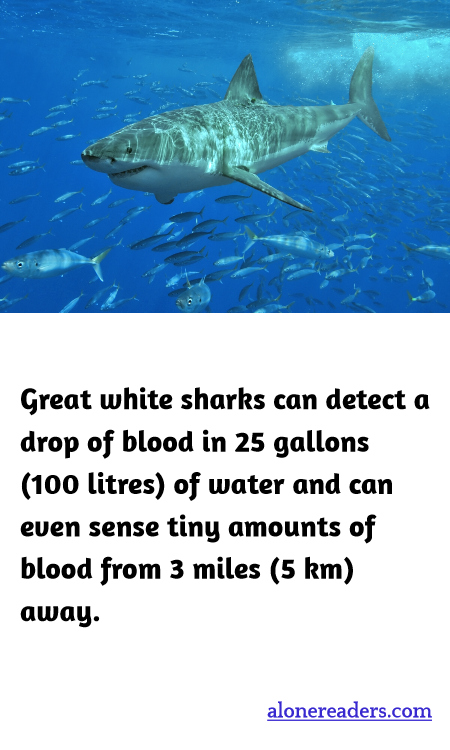
Great white sharks, often characterized as one of the ocean's most powerful predators, possess an extraordinary sensory system that enhances their ability to detect prey across great distances. One of the most fascinating aspects of this ability is their acute sense of smell, which allows them to detect a drop of blood in 25 gallons (100 liters) of water—an impressive feat that highlights their efficiency as hunters. This keen olfactory sensitivity enables them to pick up on the faintest traces of blood as far as 3 miles (5 kilometers) away, guiding them directly to a potential food source.
This sensory prowess is supported by the great white shark's uniquely structured nose, which is packed with millions of sensitive receptors. These receptors can identify the chemical components of blood and other bodily fluids from marine animals in distress. This capability not only increases their success rate in hunting but also their ability to scavenge for food, allowing them to find the remains of dead animals that are not detectable by many other predators.
The biological implications of this are significant, as it affects how great white sharks impact marine ecosystems. By being able to sense blood and other organic materials at such vast distances, great white sharks help regulate the population of sea creatures, keeping a balance that might otherwise be disrupted by overpopulation or disease. This role as a top predator reinforces the complexity of marine food webs and the importance of each species within it.
Moreover, understanding these sensory abilities of great white sharks can also aid in the efforts to conserve them. With many populations declining due to overfishing, habitat loss, and the impacts of climate change, insights into their hunting behaviors and migrations based on olfactory cues can lead to better-informed conservation strategies. Strategies that ensure these apex predators do not lose their place in the oceanic ecosystem are crucial for maintaining the health of these environments.
Hence, the ability of great white sharks to detect such minute quantities of blood over such large distances is not just a curious fact; it is a testament to their evolutionary success as predators and their critical role in marine ecosystems. As research continues to unravel the mysteries of these magnificent creatures, it becomes increasingly evident how much there is to learn from their adaptations and survival strategies.