More About This Card
Living under the sweltering heat of the sun in a desert might seem daunting, yet some of the world's fastest-growing and culturally rich cities are situated in or near desert regions. These cities, despite their challenging climates, showcase impressive adaptability and thriving urban development.
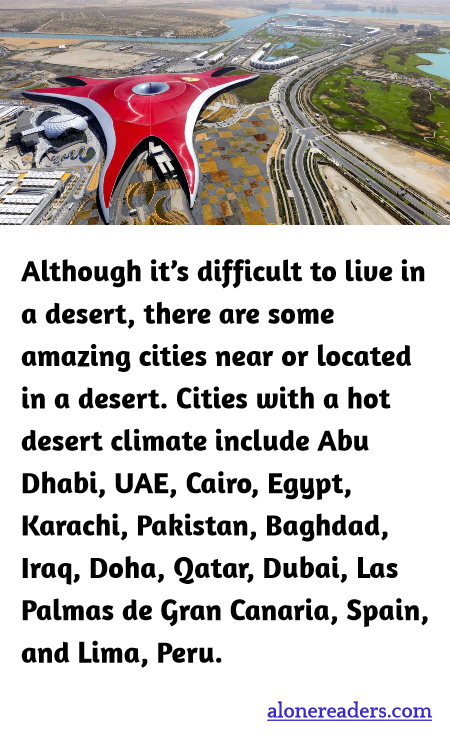
Abu Dhabi, the capital of the United Arab Emirates, is an exemplary city known for its visionary urbanism and lush, man-made green spaces that defy the arid environment. From its vast, watery mirages of wealth and palm trees juxtaposed against stark sandy backgrounds, the city reflects a unique blend of tradition and futuristic aspirations.
Not far from Abu Dhabi, Dubai is another emirate that has turned its desert base into a luxury playground noted for its skyscrapers, including the tallest building in the world, the Burj Khalifa. Dubai’s aggressive tourism and real estate developments have transformed it into a global city and a hub for airlines connecting the East and West.
Moving to the African continent, Cairo, Egypt, serves as one of the paramount historical centers in a desert setting. Founded in the 10th century, it sits near the Nile River and the Great Pyramids, largely sustaining its populace with rich cultural heritage and the longest river in the world.
Karachi, Pakistan, another desert city, is known as the country's cosmopolitan hub. As the most populous city in Pakistan, it plays an essential role in the nation's economy. Karachi is a testament to growing urban environments in challenging terrains, balancing between its arid climate and the Arabian Sea, which moderates its weather.
In Western Asia, Baghdad, Iraq, and Doha, Qatar mirror the resilience and strategic growth seen in other desert cities. Baghdad, historically a significant cultural and intellectual center, is rediscovering its potential amid recovery and rehabilitation efforts. Doha, on the other hand, basks in its modernity and wealth driven by natural gas and oil reserves, hosting an expansive skyline and growing infrastructure.
Interestingly enough, desert cities are not exclusive to the typical sandy and barren landscapes. Las Palmas de Gran Canaria, Spain, for instance, draws a contrasting picture with its location on an island but in an environment influenced by the Sahara Desert. This city enjoys a mild desert climate, which makes it a popular European tourist destination.
Lastly, Lima, Peru, despite its proximity to the Pacific Ocean, is technically a desert city. It rarely sees rain and is characterized by a foggy and cloudy climate, yet it thrives as the capital of Peru with significant cultural and architectural contributions to South America.
These cities are vivid examples of human ingenuity and determination, demonstrating that even the most seemingly inhospitable environments can foster successful, vibrant communities.