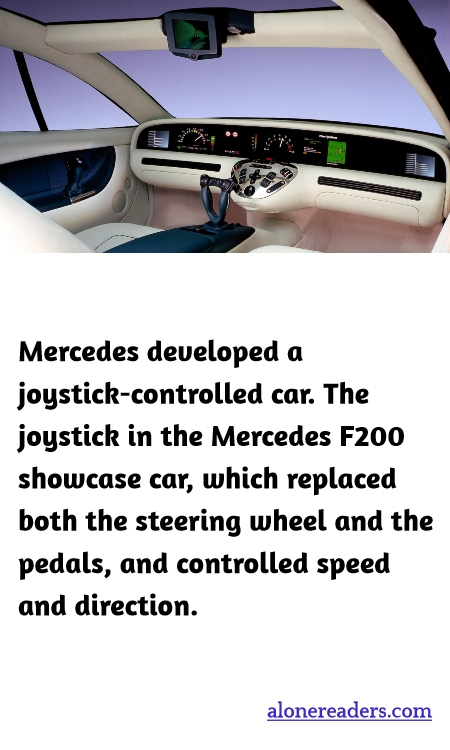
In the innovative sphere of automotive technology, Mercedes-Benz has often been at the forefront of integrating futuristic concepts into tangible prototypes. One of the most compelling advancements was the joystick-controlled Mercedes F200 showcase car. Introduced in the mid-1990s, this car revolutionized traditional driving mechanics by eliminating the need for a steering wheel and pedals, replacing them with dual joysticks located on either side of the driver's seat. This concept wasn't just a flight of fancy but a serious inquiry into the future of automotive design and user interface.
The use of joysticks to control the car allowed for a drastic redesign of the interior space, offering new possibilities for ergonomic layout and driver comfort. In the Mercedes F200, each joystick controlled different aspects of the car's movement; the left joystick primarily managed acceleration and braking, while the right joystick was responsible for steering. This setup aimed to provide a more intuitive driving experience, significantly reducing the physical movements required to operate the vehicle.
Moreover, the joystick system was seen as a step towards more accessible vehicle control systems, potentially benefiting drivers with physical disabilities who might find traditional pedals and steering wheels challenging to use. The design also anticipated future advancements in drive-by-wire technologies, where physical controls are replaced by electronic systems, offering quicker and more precise responses to driver input.
However, despite its innovative design and potential benefits, the joystick-controlled system did not become mainstream. The stark deviation from conventional driving controls posed a considerable learning curve and required drivers to relearn basic driving skills, which could be a significant deterrent for many. Additionally, the regulatory and safety implications of such a system were also a hurdle, as exhaustive testing and adaptations would be necessary to ensure that the joystick-controlled cars met the stringent safety standards applied to traditional vehicles.
Nonetheless, the Mercedes F200 serves as an important milestone in the evolution of automotive technology, highlighting the industry's exploration of alternative control systems and the continual push towards more adaptive, personalized driving experiences. As autonomous and semi-autonomous technologies continue to develop, elements of the F200's joystick control system may resurface, adapted in new contexts where drivers may prefer different modes of interaction with their vehicles.
