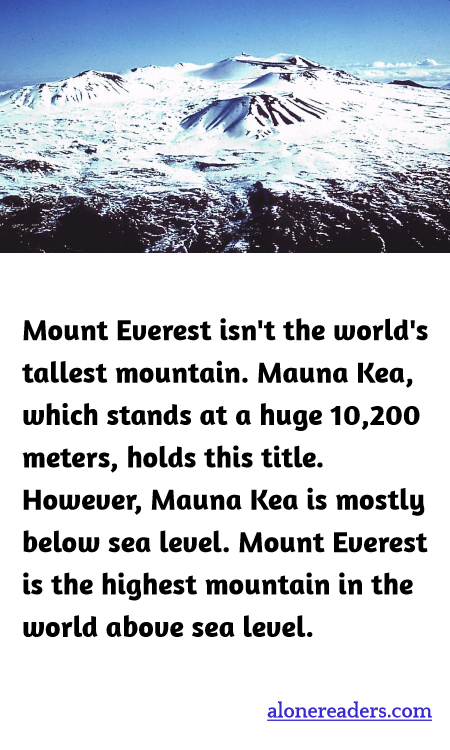
Mount Everest, standing at an impressive 8,848 meters above sea level, is widely recognized as the highest mountain in the world, drawing adventurers and climbers from every corner of the globe. Yet, when considering the total height from base to peak, it is Mauna Kea, a massive mountain that forms part of the Hawaiian Islands, that claims the title of the tallest mountain on Earth. Mauna Kea has an altitude of 4,207 meters above sea level, but when measured from its underwater base on the Pacific Ocean floor, it rises over 10,000 meters, making it significantly taller than Everest.
The distinction lies in how the heights of mountains are traditionally measured. Mount Everest's height is calculated based on its elevation above sea level, which is the standard for measuring the heights of mountains and the basis for determining the "highest" mountain. In contrast, the full height of Mauna Kea, much of which is submerged beneath the ocean's surface, is often overlooked in discussions about mountain heights because the portion that rises above sea level is less than half of its total measurement.
Further adding to Mauna Kea's significance, it is a dormant volcano that last erupted approximately 4,600 years ago, making it not only an astonishing natural monument in terms of size but also a fascinating site for scientific study. Researchers continually study its geology, ecology, and the unique habitats it supports, ranging from its underwater base rising all the way up to its icy summit.
Although Mount Everest retains the famous title for "highest mountain above sea level," reflecting our human fascination with the points where earth meets sky, Mauna Kea stands as a reminder of the hidden wonders that lie beneath the ocean's surface, encompassing a great part of Earth’s topographical variance. This highlights the various ways mountains can be measured and appreciated, offering multiple perspectives on what makes a mountain truly "tall." Such measurements challenge and expand our understanding of the natural world, pushing the boundaries of exploration both above and below sea level.
