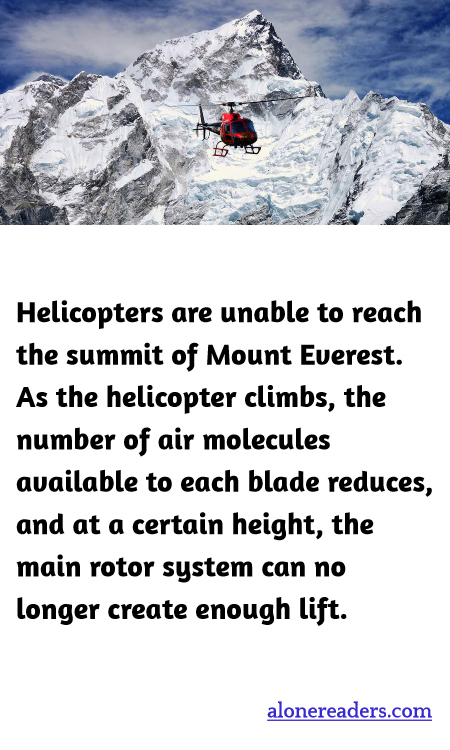
Helicopters are marvels of modern engineering, capable of performing feats such as hovering in place, flying backwards, and reaching places inaccessible to most other forms of transportation. However, even these versatile machines have their limits, one of which becomes starkly evident when considering the possibility of a helicopter reaching the summit of Mount Everest, the world's highest peak at approximately 29,029 feet above sea level.
The challenge for helicopters trying to reach such extreme altitudes lies primarily in the nature of their operation. Helicopters lift off and maneuver by generating lift through their rotor blades, which slice through the air, creating differences in air pressure that allow the craft to rise and move. As altitude increases, air density decreases because the gravitational pull of the Earth lessens slightly, and the atmosphere thins. This reduction in air density means that at higher altitudes, there are fewer air molecules for the rotor blades to interact with each time they rotate.
When a helicopter attempts to ascend to the heights of Mount Everest, it encounters this problem of rapidly thinning air. The thinner air at such high altitudes provides less lift for the rotor blades, making it increasingly difficult for the helicopter to continue rising as it climbs higher. Beyond a certain point, the air becomes so thin that the blades cannot generate sufficient lift to overcome the weight of the helicopter.
Moreover, helicopters are also constrained by their power-to-weight ratio, which affects their performance at high altitudes. Increasing altitude requires more power to achieve the same amount of lift, due to the reduced air density. However, helicopter engines, like all internal combustion engines, rely on oxygen to operate. With less oxygen available at higher altitudes, engines produce less power, further compounding the difficulty of generating sufficient lift.
Despite these challenges, helicopters have still managed to make impressive high-altitude flights, with some reaching more than 25,000 feet. The absolute record for the highest altitude landing and takeoff by a helicopter was set by Didier Delsalle of France in 2005 when he landed a Eurocopter AS350 Squirrel on Mount Everest at an altitude of 29,029 feet. However, this feat required ideal weather conditions and a specially modified helicopter to handle such a combustive challenge. Moreover, the flight was exceptional and is not practical for regular operations.
In essence, while the power and versatility of helicopters allow them to perform a wide array of tasks and reach difficult locations, the summit of Mount Everest presents a unique and formidable challenge. The thin air near the peak limits the effectiveness of the rotor blades and engine power, making standard helicopter flights to the summit inviable under normal conditions. Thus, while helicopters can approach the vicinity of Everest, the peak itself remains beyond the reliable, safe operational ceiling for most helicopters, barring extraordinary circumstances.
