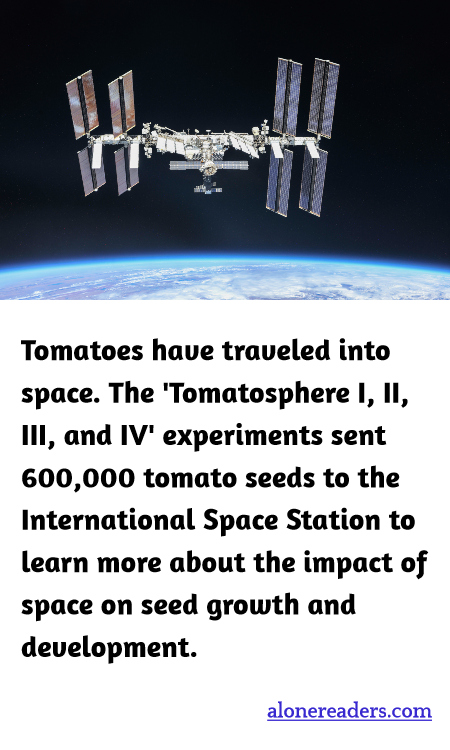
Tomatoes, a staple in diets across the world, have not only made their mark on Earth but also beyond, venturing into the realm of space through a series of intriguing experiments known as the 'Tomatosphere I, II, III, and IV.' These experiments involved sending approximately 600,000 tomato seeds to the International Space Station (ISS). The primary aim behind Tomatosphere was to investigate the impact of the space environment on the growth and development of seeds, particularly how microgravity and cosmic radiation might alter their biological processes.
By sending seeds into space, scientists hoped to gather insights that could help in understanding potential changes in plant biology under space conditions. Such research is crucial for future long-duration space missions, such as missions to Mars, where astronauts will rely on growing their own food during extended stays. The findings could also have implications for improving crop production and sustainability on Earth, especially in challenging environments.
Upon the return of these seeds to Earth, they were distributed to thousands of students across various countries to grow and observe, creating a mass participatory experiment wherein young minds could contribute to real scientific research. Students compared the growth of 'space seeds' with those that had stayed on Earth, noting any differences in germination rates, growth speed, and overall health. This hands-on educational project not only spurred interest in space science and agriculture among young students but also aimed at inspiring the next generation of scientists and researchers.
The implications of Tomatosphere extended beyond mere agricultural interest; they delved into potential changes in nutritional values, resistance to pests, and overall plant behavior in altered environments. Such comprehensive studies are pivotal in the context of global challenges like food security and environmental sustainability.
As humanity eyes a future amongst the stars, experiments like the Tomatosphere serve as a critical bridge between our life on Earth and the unknowns of outer space. Stretching the bounds of what is agriculturally possible while educating and engaging the public, the journey of tomato seeds into space symbolizes a small but significant stride towards mastering the science of extraterrestrial agriculture. Their journey is not just about growing food but about nurturing the seeds of curiosity and innovation needed to thrive in new frontiers.
