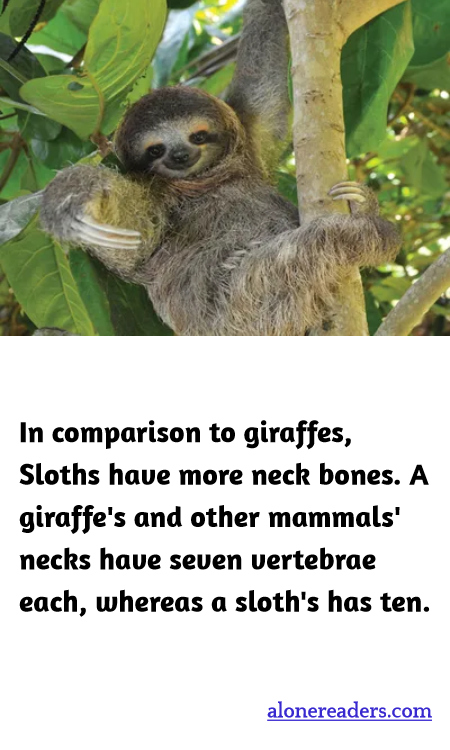
Despite their markedly different appearances and habitats, giraffes and sloths share a surprising similarity in terms of their evolutionary adaptations, particularly in the structure of their necks. Both animals have adapted remarkably to their environments, but in distinctly unique ways that are reflected in the anatomy of their necks.
Giraffes, towering giants of the African savannah, are renowned for their long necks which help them reach the leaves of tall trees, an essential advantage for survival in an ecosystem where food sources are spread vertically. Interestingly, however, they only have seven cervical (neck) vertebrae, which is the same number found in most mammals, including humans. The magic lies in how these bones are structured: giraffe neck vertebrae are elongated, allowing them to extend their necks to impressive lengths.
Sloths, on the other hand, dwell primarily in the dense canopies of Central and South American rainforests. Their environment is also vertically layered, but unlike giraffes, sloths benefit from a greater number of cervical vertebrae. They have up to ten, depending on the species (some have eight or nine), which is unusual for mammals. This adaptation grants sloths extraordinary neck flexibility, enabling them to reach leaves around them and look out for predators without having to move their bodies—a crucial survival tactic given their slow-moving nature.
This exceptional difference in vertebrae count between sloths and giraffes (and indeed most other mammals) highlights the fascinating ways in which different species have evolved anatomically to thrive in their specific environments. The evolutionary path has favored elongation in giraffes for reaching scarce food sources high up, while in sloths, a greater number of vertebrae allows for a versatile range of motion, vital for their survival in the predator-rich rainforest.
Both giraffes and sloths have thus optimized their neck structures in ways that best suit their dietary needs and protective strategies, demonstrating nature's ingenuity in adapting its creatures to their surroundings. This anatomical variation serves as a clear example of how different pressures in an environment can shape the evolution of a species in quite diverse directions.
