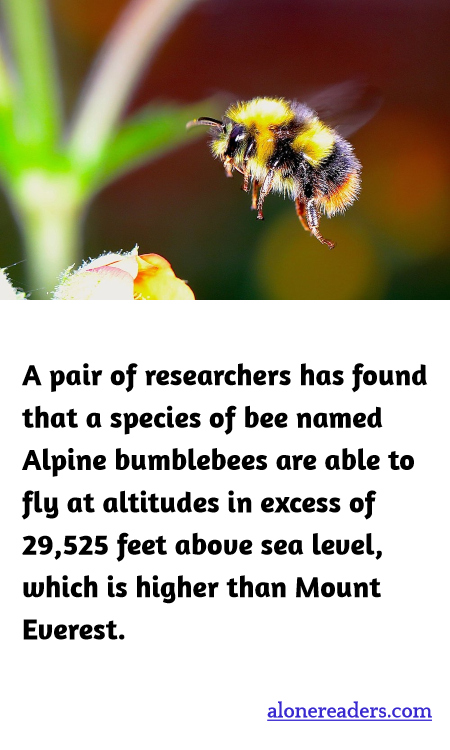
In a groundbreaking discovery, a pair of researchers has found that Alpine bumblebees have the astonishing ability to fly at heights exceeding 29,525 feet, surpassing the summit of Mount Everest, the highest peak on Earth. This remarkable capability challenges previous assumptions about the limits of insect flight at such extreme altitudes, where the air is thin and temperatures are harsh.
Alpine bumblebees, typically found in mountainous regions, have evolved unique adaptations that enable them to survive and thrive in low-oxygen environments. Their wings are larger compared to other bumblebee species, providing greater lift, and their metabolism is specially tuned to remain active in cold temperatures, a necessity when flying at high elevations.
The researchers conducted their study by simulating high-altitude conditions and observing the bees' flight capabilities in a controlled environment. The bees were placed in a flight chamber where air pressure and temperature could be adjusted to mimic conditions found at various altitudes. Surprisingly, the Alpine bumblebees were not only able to fly in these extreme conditions, but they could also effectively navigate and maintain stability, which is critical for foraging and survival.
This discovery not only sheds light on the physiological and biochemical adaptations of Alpine bumblebees but also raises questions about the ecological impacts of such adaptations. Understanding how these bees can operate at such altitudes might provide insights into how insects and other animals might respond to changing climatic conditions, particularly in mountainous regions that are significantly affected by climate change.
Moreover, the finding paves the way for further research into how other species adapt to extreme environments and could have broader implications for evolutionary biology and environmental sciences. As temperatures worldwide continue to shift, and high-altitude habitats may become more hospitable or inhospitable, studies like this could be crucial in predictive models of biodiversity responses to climate change. This fascinating example of Alpine bumblebees flying high above the clouds extends our understanding of the natural world's complexity and resilience.
