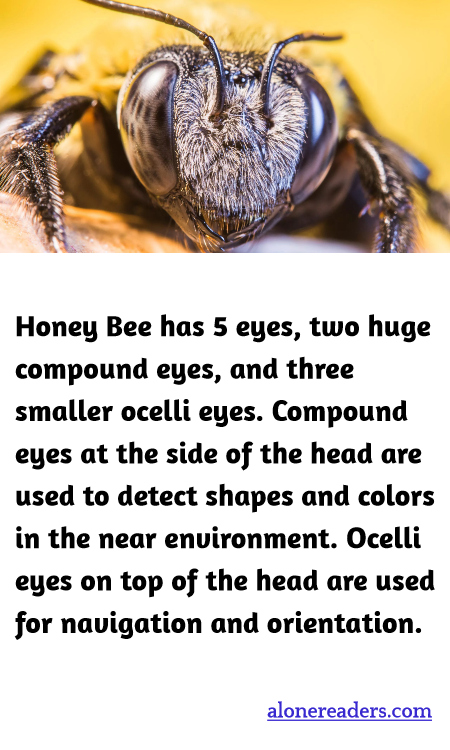
Honey bees are marvels of natural engineering with an intricate vision system comprising five eyes: two large compound eyes and three smaller ocelli eyes. Each set of eyes serves a distinct purpose that is crucial for the bee’s survival and efficient functioning within its environment.
The compound eyes are easily the more conspicuous of the five, located on either side of the bee’s head. These eyes are made up of thousands of tiny lenses known as ommatidia, which allow honey bees to perceive a wide range of colors, including ultraviolet light. This ability is vital for identifying various flower species from which to collect nectar. Moreover, the large field of view and rapid processing capabilities of the compound eyes enable bees to detect movement very effectively, an essential trait for avoiding predators and navigating through dense vegetation.
On the other hand, the three smaller ocelli eyes, situated on the top of the bee's head, have a more specialized function. These are simple eyes that do not form complex images like the compound eyes but are sensitive to light intensity. The primary role of the ocelli is to assist in navigation. By detecting the light of the sun and the UV light patterns in the sky, which remain even on cloudy days, these eyes help bees maintain their orientation during flight. This is crucial for their remarkable ability to travel significant distances away from the hive and return accurately without losing their way.
Understanding how bees use their five eyes can provide insights into other aspects of their behavior and social organization. For instance, their ability to navigate and communicate about the location of food sources relies heavily on their visual capabilities. Honey bees perform a "waggle dance" to communicate the direction and distance of flowers to hive mates, a process that depends on accurate sunlight angle perception provided by their ocelli.
The study of honey bee vision not only fascinates those interested in natural history and animal behavior but also has practical applications. For example, understanding how bees perceive environmental cues can help in designing more effective strategies for bee conservation and management, ensuring these critical pollinators continue to thrive and support global agriculture.
In conclusion, the honey bee’s five eyes are a striking example of evolutionary adaptation that equips them for complex tasks ranging from navigation to foraging. These visual tools are integral in making the honey bee one of nature’s most efficient pollinators. As research continues, there is undoubtedly much more to learn from these fascinating insects about both the biological complexities of vision and the ecological roles they fulfill.
