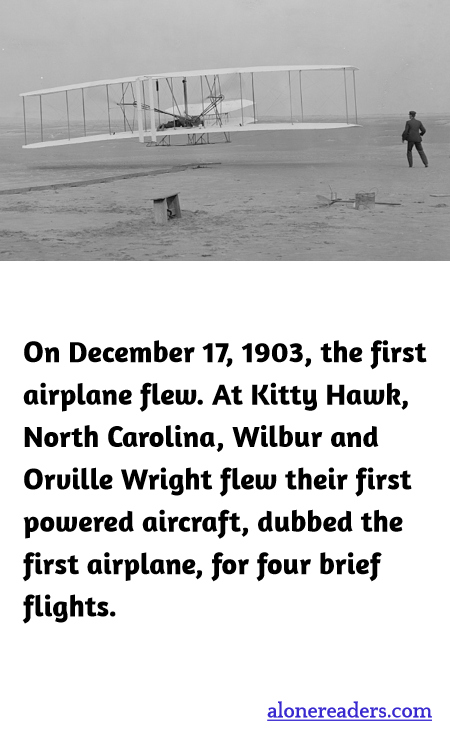
On a cold December morning in 1903, the quiet expanse of Kitty Hawk, North Carolina, witnessed a pivotal event in human history. Wilbur and Orville Wright, two visionary brothers from Dayton, Ohio, achieved the first controlled, powered, and sustained heavier-than-air human flight. The aircraft, known as the Wright Flyer, was a culmination of years of experimentation and innovation in aerodynamics and propulsion.
The Wright brothers, originally bicycle makers, had been fascinated by the idea of flight from an early age. This fascination was fueled by the stories and experiments of earlier aviation pioneers. Their mechanical experience with bicycles taught them the importance of balance and control, concepts they would later apply to their flying machines. Before the trials at Kitty Hawk, they conducted extensive glider tests and developed their theories on aerodynamics and control mechanisms.
December 17, 1903, marked their first successful trial. The Wright Flyer, made of spruce and fabric and powered by a small, custom-built gas engine, took off with Orville at the controls for a 12-second flight, covering 120 feet. This was followed by three more flights that day, with the brothers taking turns piloting. Wilbur’s longest flight lasted 59 seconds and covered 852 feet. Each flight was progressively longer as they gained better control and understanding of their machine.
These flights were significant for several reasons. Most notably, the Wrights had invented three-axis control, which enabled the pilot to steer the aircraft effectively and to maintain its equilibrium. This method became standard on all fixed-wing aircraft and marked a true turning point in aerial navigation.
The impact of the Wright brothers' flights at Kitty Hawk rippled across the globe, inspiring a generation of aviators and accelerating advancements in aerial technology. Today, their innovation is recognized as a monumental stepping stone not just in aviation, but in the way humanity perceived and conquered the challenges of travel and transportation.
Though the initial public and media reaction was skeptical, and the significance of their achievement was not immediately recognized, history would vindicate the Wrights' vision and technical acumen. Their work laid the foundational principles of modern aeronautics, and their relentless pursuit of their dream set a precedent for the innovative spirit that would characterize the 20th century’s technological advances. The Wright Flyer itself became an iconic symbol of innovation and perseverance, and the date of its flight a celebration of human ingenuity and the relentless pursuit of dreams.
