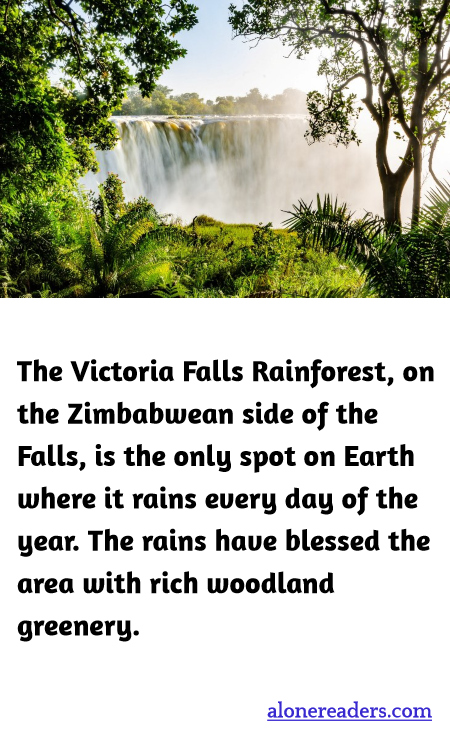
Victoria Falls, one of the largest and most famous waterfalls in the world, presents a spectacle of awe-inspiring beauty and grandeur on the Zambezi River, forming the border between Zambia and Zimbabwe. The Victoria Falls Rainforest, uniquely situated on the Zimbabwean side of the falls, enjoys a phenomenal natural occurrence. It is the only place on the planet where you can experience rainfall every single day of the year.
This continuous daily rainfall is not caused by weather patterns as one might expect, but rather by the massive spray churned up by the falling water from the heights of the falls. As the Zambezi River plummets down the 108 meter drop, it creates a mist that can rise up to 400 meters in the air and be seen from kilometers away. When this mist precipitates, it forms what is locally known as "rainfall," nourishing the lush, dense rainforest surrounding the falls.
The microclimate created by this constant mist allows for a vibrant ecosystem to thrive. The Victoria Falls Rainforest boasts a rich array of woodland greenery, with a stunning variety of ferns, palms, liana vines, and several other plant species that are rare or seldom found elsewhere in Zimbabwe. This ecological abundance extends to the wildlife too; the area is inhabited by a diverse range of animals and birds, some of which are endemic to the region.
Walking through the rainforest, visitors are enveloped in a surreal environment where sunlight struggles to penetrate the thick foliage and the sound of the falls resonates through the air. Paths and viewpoints throughout the rainforest offer varying perspectives of the falls, with some areas so close that one can feel the spray from the waterfall on their skin.
The Victoria Falls Rainforest provides not only a unique ecological habitat but also an extraordinary travel experience. It's a testament to the power and beauty of nature, showcasing how a natural phenomenon can shape not just the landscape but also the biodiversity that depends on it.
