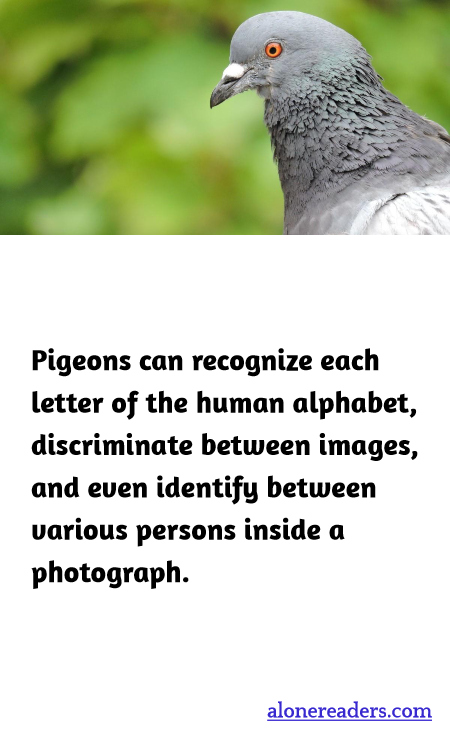
Pigeons, those ubiquitous city dwellers often dismissed as mere urban pests, have cognitive abilities that might surprise many. These birds are not only capable of remarkable feats of memory, but they can also engage in more complex recognition tasks than previously understood. Research into bird intelligence, particularly pigeons, has revealed that these creatures have the ability to recognize each letter of the human alphabet, a task that requires advanced visual processing capabilities and a higher level of cognitive function.
The ability of pigeons to discriminate between different images adds another layer to our understanding of their cognitive abilities. In controlled experiments, pigeons have been shown to differentiate between photographs, and even between different two-dimensional representations of objects, which demands a sophisticated level of perceptual processing. For instance, when shown images of chairs and tables alternated in random sequences, pigeons learned to peck a key to indicate the presence of a chair, thereby demonstrating not only recognition but also categorization abilities.
Furthermore, pigeons have demonstrated the ability to recognize individual humans within photographs. This skill implies an advanced level of visual acuity and memory, as the task requires the birds to discern and recall the distinguishing features of different people. The process involves not only recognizing a person based on a two-dimensional image but also being able to maintain that recognition across varying contexts and presentations within photographs.
These insights into pigeon intelligence are not merely academic curiosities but have practical implications as well. Understanding how pigeons and other birds process visual information can inform better designs in artificial vision systems, such as those used in autonomous vehicles or robotic systems. By studying the mechanisms behind pigeons' recognition capabilities, researchers can develop more effective algorithms for pattern recognition and image processing in technological applications.
Moreover, these findings challenge the often simplistic views held about animal intelligence, especially in species that are not traditionally considered to be particularly smart. The abilities of pigeons to recognize letters, discriminate between images, and identify human faces in photographs suggest a level of cognitive sophistication that demands a reevaluation of their potential. This not only expands our comprehension of the avian brain but also enriches our broader understanding of the animal kingdom's intellectual capacities. Thus, the humble pigeon, far from being just another city slicker, emerges as a key player in the ongoing exploration of animal cognition.
