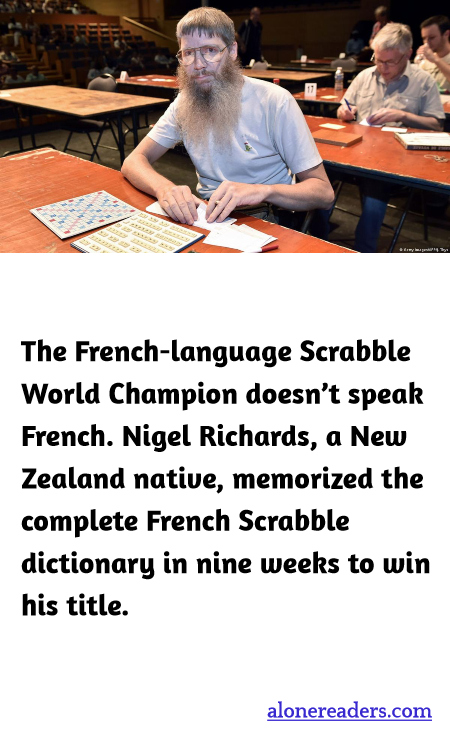
In the world of competitive Scrabble, mastery of vocabulary is a fundamental key to success. However, Nigel Richards, a New Zealand native, pushed the boundaries of this premise to an impressive extreme. Richards, who is primarily an English speaker, achieved a remarkable feat by winning the French-language Scrabble World Championship, despite not speaking French fluently. His secret? An extraordinary memory and a strategic approach that involved memorizing the complete French Scrabble dictionary in just nine weeks.
Richards' journey in the world of Scrabble is marked not only by his talent but also by his unorthodox methods of preparation. His ability to memorize such vast amounts of information in a relatively short period is a testament to his exceptional cognitive skills. This strategy, though seemingly straightforward, is far from easy. It requires intense concentration, dedication, and a methodical approach to the memorization process. By learning the dictionary, Richards equipped himself with the necessary tools to excel, focusing purely on the words as game elements rather than components of language for communication.
This remarkable achievement has not only earned him the championship title but has also placed him in the spotlight as an extraordinary figure in the world of Scrabble. The victory also sparked discussions about the nature of language learning and cognitive development. Some might argue that his approach, while undeniably effective for the game's purpose, sidesteps the cultural and communicative essence of language. Yet, it underscores an essential aspect of Scrabble as a game where word recognition, recall, and strategic placement are more critical than understanding meaning or context.
Richards’ success has raised intriguing questions about the boundaries between language as a tool for communication and as an element of competitive play. It challenges conventional notions about language proficiency, suggesting that there are multiple ways to 'know' a language, depending on one's goals and context. This approach has not only proven successful in Scrabble but also provides a broader insight into how different skills can be applied in unusual but effective ways.
In essence, Nigel Richards’ accomplishment is a fascinating study of memory, strategy, and the mechanics of language. It highlights a remarkable intersection of language and game, cognitive skill and strategic thinking, demonstrating that sometimes, winning strategies come from the least expected places.
