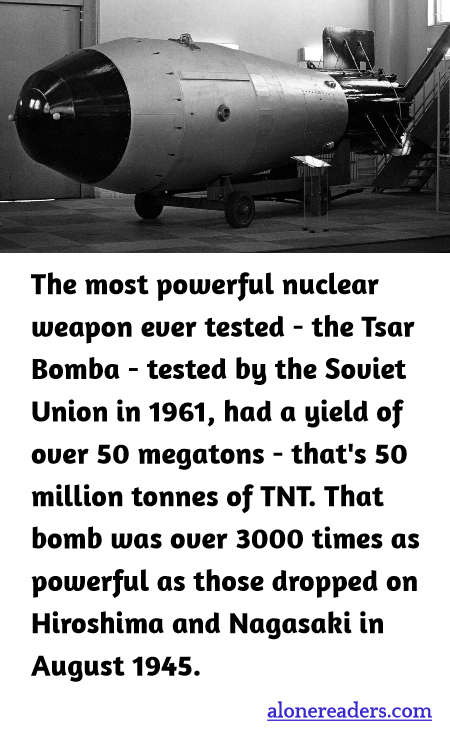
On October 30, 1961, the Soviet Union detonated the largest and most powerful nuclear weapon in human history, known as the Tsar Bomba, over the remote Novaya Zemlya archipelago in the Arctic Ocean. The bomb was originally designed to have a yield of up to 100 megatons of TNT; however, in a late decision to reduce the fallout, its yield was reduced to approximately 50 megatons. This adjustment did little to diminish its awe-inducing power, as the resulting explosion still equated to about 50 million tonnes of TNT, making it more than 3000 times more powerful than the atomic bombs dropped on Hiroshima and Nagasaki in 1945.
The shockwave from the Tsar Bomba circled the Earth three times, and the mushroom cloud reached a height of 60 kilometers (37 miles), roughly seven times the height of Mount Everest. The light from the explosion was visible from a distance of over 1,000 kilometers. Despite being detonated 4 kilometers above the ground, the heat from the explosion caused third-degree burns up to 100 kilometers away.
The Tsar Bomba was primarily a show of strength, a part of the intense nuclear arms race and the cold war-era posturing between the United States and the Soviet Union. The bomb was never intended for actual warfare, and despite its successful detonation, it raised immediate international concerns over the destructive power of nuclear weapons. The test highlighted the cataclysmic potential of nuclear warfare and added impetus to calls for arms control and disarmament.
The aftermath of Tsar Bomba's detonation had lasting impacts on international relations and nuclear policy. The sheer scale of its destructive capacity led both superpowers to reconsider the practicality and risk of maintaining and testing such powerful weapons. Subsequently, this resulted in several nuclear test ban treaties, including the Limited Test Ban Treaty of 1963, which prohibited all test detonations of nuclear weapons except for those conducted underground. Such treaties were significant steps toward the mitigation of nuclear arms proliferation, reflecting a global acknowledgment of the devastating consequences highlighted by the Tsar Bomba explosion.
