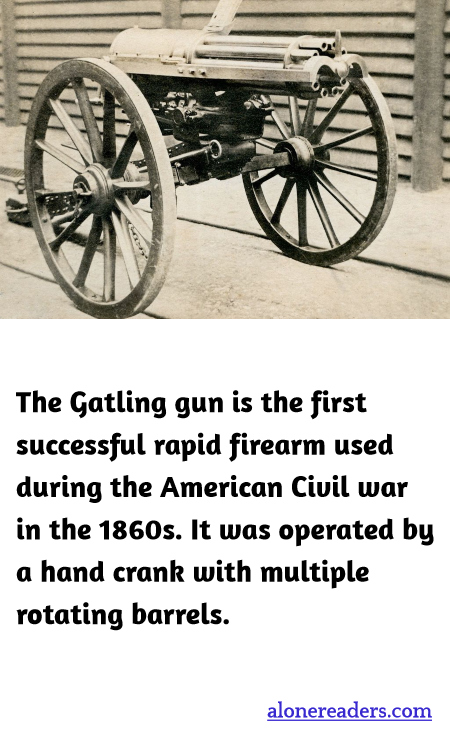
The Gatling gun, a name synonymous with the early evolution of firearm technology, marked a significant leap during the tumultuous times of the American Civil War in the 1860s. Invented by Dr. Richard J. Gatling, a North Carolina-born inventor, the machine was introduced with the idea of reducing the size of armies and, consequently, the number of deaths during military engagements, through a weapon that boasted unprecedented rates of fire.
The Gatling gun is distinguished by its design—it featured multiple barrels (usually six to ten) that rotated around a central axis, enabling it to achieve a firing rate that was unheard of at the time. It wasn't fully automatic in the modern sense, as it required a soldier to turn a hand crank to rotate the barrels and cycle the ammunition. This mechanism prevented the barrels from overheating and allowed the gun to sustain firing over prolonged periods.
Operationally, the Gatling gun used metallic cartridges, which were fed into the weapon by gravity from a top-mounted magazine, an innovation in itself at that time. When the crank was turned, each barrel would align with a mechanism that loaded a cartridge, fired it, and ejected the casing in succession. This enabled the Gatling gun to achieve a rate of fire that was simply unmatched by other firearms of the era, capable of delivering up to several hundred rounds per minute.
Although designed and patented in 1862, the Gatling gun was not immediately adopted by the Union army. It saw limited use during the Civil War mainly due to high production costs and the military's initial mistrust of new technology. However, its effectiveness in battle gradually earned it favor among some commanders who used it to great effect to repel Confederate attackers.
Post-war, the Gatling gun continued to evolve and saw action in numerous other conflicts around the world, paving the way for the development of modern automatic weapons. It remained in military service into the early 20th century, epitomizing the transition from single-shot rifles to rapid-fire guns. This remarkable invention not only changed how battles were fought but also had a lasting impact on the future direction of military armaments.
