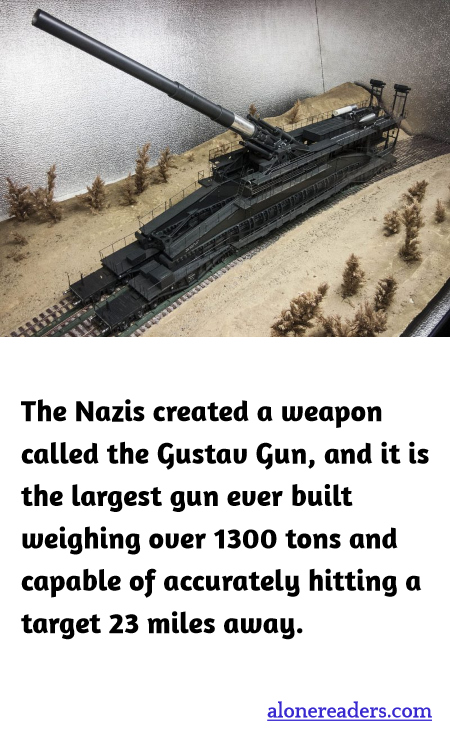
During World War II, the Nazis engineered several formidable weapons, but one of the most awe-inspiring was the Gustav Gun, also known commonly as Schwerer Gustav (Heavy Gustav). This colossal railway gun, the largest ever built, stands as a stark symbol of the extreme military ambitions of the Third Reich. Weighing a staggering 1,350 tons, the Gustav Gun was not only monumental in size but also in firepower and range.
Developed by the German arms manufacturer Krupp, the Gustav Gun was designed to penetrate the formidable Maginot Line fortifications along the French border. With an 80-cm caliber barrel, the gun could fire shells weighing seven tons to a distance of approximately 23 miles (37 kilometers). The sheer power of its ammunition was enough to destroy concrete fortifications and heavy bunkers, making it a terrifying tool of war.
The complexity and size of the Gustav Gun meant that it required a crew of over 500 men to assemble and operate. The assembly process alone could take several weeks, and the gun had to be mounted on specially constructed railways to accommodate its enormous size and weight. Despite its impressive capabilities, the Gustav Gun was not widely used in combat. It saw action during the siege of Sevastopol in the Soviet Union, where it was used to destroy underground ammunition stores and fortifications with remarkable accuracy. However, the logistical challenges associated with moving and setting up the gun limited its deployment.
As the war progressed, the Gustav Gun became more of a liability than an asset due to its inability to be rapidly redeployed. The advancements in aerial bombardment and mobility of forces made such stationary and cumbersome weapons less practical on the modern battlefield. Towards the end of the war, as the Allies advanced through Europe, the Germans destroyed the Gustav to prevent its capture.
Today, the Gustav Gun remains a subject of fascination for military historians and enthusiasts. Its design and sheer scale represent the lengths to which the Nazi regime went to outmatch their adversaries through technological advancements. Yet, the Gustav also serves as a reminder of the resource-heavy and ultimately impractical weapon systems that were pursued at great cost during the war. The legacy of the Gustav Gun symbolizes not just human ingenuity in engineering but also the devastating potential of such ingenuity when applied to instruments of war.
