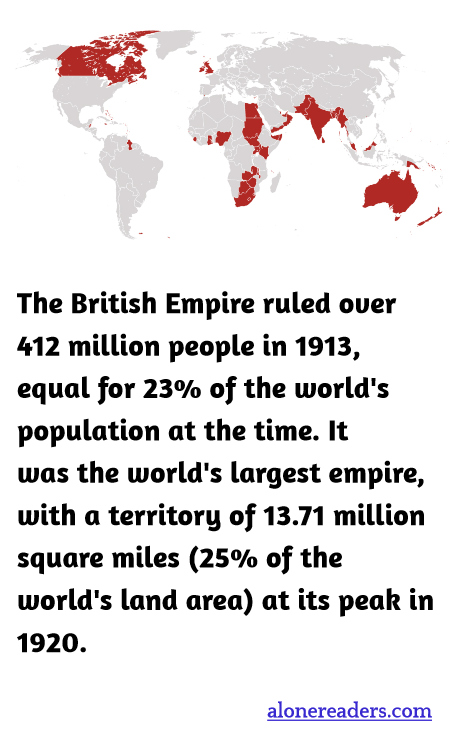
The British Empire, at its zenith, was an unparalleled global force, shaping politics, economies, and cultures across various continents. By 1913, it governed over 412 million people, which constituted about 23% of the world’s population at that time. This expansive control illustrated not just the scale but also the influence the Empire wielded worldwide. The imperial reach extended even further by 1920 when the British Empire encompassed around 13.71 million square miles, which represented about 25% of the world's land area. Such vast territories included diverse regions in Africa, Asia, the Americas, and Oceania.
The immense size of the Empire was a result of centuries of exploration, trade, naval dominance, and sometimes, outright conflict and conquest. Key motives driving the expansion included the search for new trading opportunities, the desire for resources, and various strategic military and naval interests. Moreover, the propagation of cultural and ideological values, such as British notions of civilization and Christianity, also played significant roles in the expansionist policies of the time.
However, ruling such an extensive empire was fraught with challenges. Administratively, it required a complex and efficient system of governance, which led to the development of significant bureaucratic structures both in London and across the colonies. Economically, the extraction of wealth and resources from these territories was central to funding British industry and maintaining its military prowess. Yet, this extraction often came at considerable human and economic cost to the local populations.
Culturally, the British impact was profound, influencing language, education, law, and governance practices in the colonies. English became a lingua franca in many parts of the world, a legacy that has persisted long after the decline of the Empire. The legal and educational systems introduced by the British also had far-reaching effects, shaping societal structures in fundamental ways.
The vast might of the British Empire began to wane in the mid-20th century as independence movements gained momentum in various colonies. The aftermath of World War II, in particular, accelerated this process, leading to a rapid decolonization period in the 1950s and 1960s. Each newly independent nation embarked on a path to reclaim and reconstruct its identity, governance, and economy post-empire.
Today, the legacies of the British Empire are mixed, marked by cultural diffusion and exchange on the one hand, and by contentious debates over the impacts of colonial rule on the other. These legacies continue to influence international relations and cultural exchanges among the former colonies and the United Kingdom, reflecting a complex historical tapestry woven during centuries of imperial rule.
