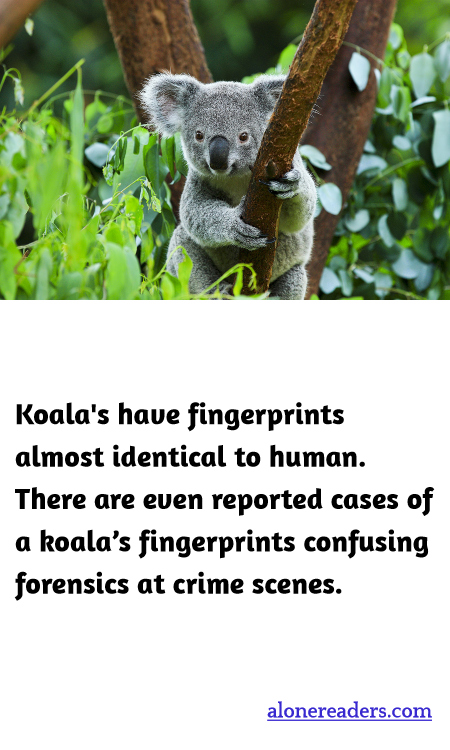
Koalas, one of Australia's most iconic marsupials, are not only renowned for their adorable appearance and tree-hugging habits but also possess an unusual human-like trait: fingerprints. Remarkably, koala fingerprints are so similar to humans' that they can confound even the most seasoned forensic experts. This surprising similarity has both fascinated and baffled scientists for years, as it raises intriguing questions about the reasons behind such evolutionary developments.
The koala's fingerprints, much like humans', have loops, whorls, and arches that are unique to each individual. These patterns are incredibly detailed and can be observed under a microscope. The resemblance is so close that there have been anecdotal accounts of koala prints being mistaken for human fingerprints at crime scenes, although these incidents are rare and sometimes considered urban myths. Nonetheless, the similarity is sufficient to potentially lead to confusion in forensic analysis, requiring experts to be particularly vigilant in areas where human and koala populations overlap.
Scientifically, the presence of fingerprints in koalas is thought to be an example of convergent evolution, where unrelated species develop similar traits independently to adapt to comparable environments or lifestyle demands. Both humans and koalas use their hands for intricate tasks. Humans manipulate objects and create tools, while koalas need to grip tightly onto tree branches as they climb. Fine-scaled fingerprints provide both species with the necessary friction and tactile sensitivity to perform these tasks efficiently.
The discovery of koalas' fingerprints was made relatively recently, in the 1970s, by a police expert in England. This finding sparked various studies to investigate the functional and evolutionary aspects of this trait in koalas. Research continues to determine how widespread this feature is in other tree-dwelling marsupials and whether it serves similar purposes.
Understanding why koalas evolved such human-like fingerprints not only sheds light on their ecology and behaviors but also enhances our knowledge of evolutionary processes in general. It compels us to think about the delicate balances of nature and evolution's power to mold unrelated creatures in eerily similar ways when faced with similar environmental challenges. This intersection of biology, evolution, and forensic science illuminates the surprising ways in which the natural world often mirrors our own, providing endless intrigue and ongoing opportunities for scientific discovery.
