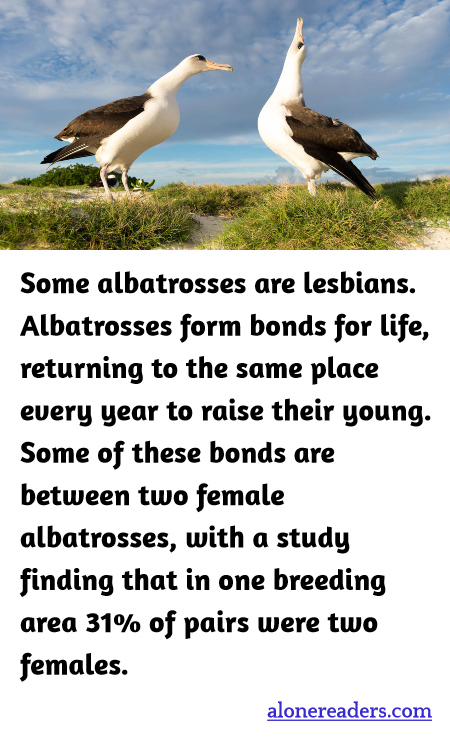
Albatrosses, known for their impressive wingspan and lifelong partnerships, exhibit a unique aspect of bonding—some of these majestic birds form same-sex pairs, particularly between females. These birds, often romanticized for their long-term monogamy, return annually to the same breeding grounds, where they engage in the ritual of raising their young. Interestingly, in certain populations, a significant percentage of these pairings involve two female albatrosses.
In a study on albatrosses, researchers discovered that in one specific breeding area, about 31% of the pairs consisted of two females. This phenomenon, which might seem unusual at first glance, highlights the adaptability and complexity of animal behaviors, particularly in social and reproductive contexts. Same-sex pairings among female albatrosses sometimes occur due to a skewed sex ratio, where the number of females significantly surpasses the number of males in the population. This imbalance prompts females to pair together to cooperatively raise chicks.
These female-female pairs engage in activities similar to those of mixed-sex pairs, including building nests together and taking turns incubating eggs. In some cases, they obtain sperm from male albatrosses to fertilize their eggs, either through brief encounters with single males or, less frequently, by intruding into the nests of established opposite-sex pairs. Despite the challenges, many of these female pairs succeed in raising chicks that survive to adulthood, demonstrating that the parental care provided by two mothers can be as effective as that provided by a male-female pair.
The existence of lesbian albatrosses provides profound insights into the flexibility of animal behavior and the importance of social bonds. It challenges traditional views on animal partnerships and reproduction, showing that nature often has diverse strategies for species survival and social interaction. Moreover, these observations contribute to a broader understanding of the natural world’s complexity, revealing that what may appear to be anomalies are often vital adaptations to specific environmental or demographic conditions. This knowledge not only enriches our understanding of albatrosses but also expands our perspective on the dynamics of wildlife relationships and the varied forms they can take.
