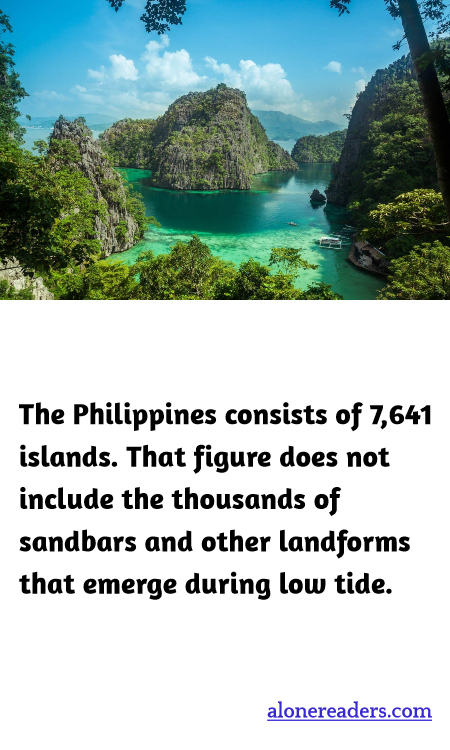
The Philippines, an archipelago in Southeast Asia, is composed of 7,641 islands, a count that underscores the country's rich geographical diversity and complex maritime boundaries. This number, however, does not even include the myriad smaller landforms such as sandbars, which appear and disappear with the ebb and flow of the tide, adding an element of changeable beauty to the Philippine seascape.
These islands are scattered over a vast area and vary greatly in size and character. The largest islands, such as Luzon and Mindanao, are well-known for their mountainous landscapes and active volcanoes, while countless smaller islands boast stunning beaches, coral reefs, and rich biodiversity. The dynamic nature of the country’s geography, with landforms that can appear and vanish with the tide, adds a layer of transient beauty but also poses unique challenges for navigation and territorial mapping.
The presence of these temporary islets like sandbars affects the local ecosystems and the livelihoods of the communities who depend on these waters for fishing and tourism. Sandbars, for instance, can provide temporary habitats for various species of birds and marine life, and they are also popular among tourists for their picturesque and pristine conditions. However, their shifting nature makes permanent settlements impossible and complicates territorial claims, an issue that is particularly sensitive in a region where maritime boundaries are often contested.
Moreover, the vast number of islands and the fluid geography necessitate a robust infrastructure for maritime and air transport, making connectivity an ongoing challenge for the archipelago. The government and local communities continuously strive to balance development with environmental conservation, ensuring sustainable growth while preserving the natural beauty and biodiversity that make the Philippines a unique and captivating destination.
Navigating through these islands, one not only traverses diverse physical landscapes but also a mosaic of cultural expressions, with each island or group of islands showcasing distinct traditions, languages, and histories. The transient sandbars and other temporal landforms further enrich this tapestry, offering a metaphor for the resilient and adaptive nature of the Filipino people and their cultures. The Philippines, with its permanent and fleeting isles alike, presents a fascinating world where land and water perpetually recreate and redefine the contours of a nation.
