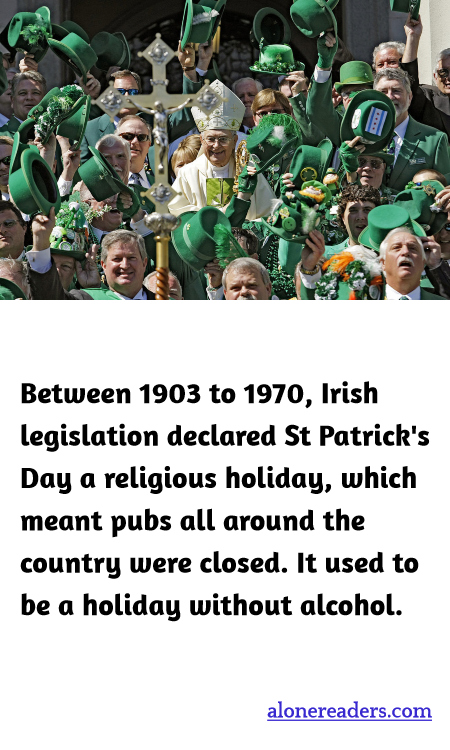
In a testament to the intertwined relationship between culture and law, Ireland's observance of St. Patrick's Day offers a fascinating historical narrative. From 1903 until 1970, Irish legislation uniquely positioned St. Patrick's Day not just as a public holiday, but specifically as a religious observance. This classification had significant cultural and social implications, notably the mandatory closure of pubs across the country on March 17th each year. This directive stemmed largely from the influence of the Catholic Church, reflecting the day's solemnity and religious significance as a feast day in the Christian liturgical year honoring St. Patrick, the patron saint of Ireland.
For decades, this legislative action enforced a dry holiday, dramatically shaping how the celebration was conducted. In a land where pub culture is deeply ingrained and functions as a critical social bond, the closure of pubs on one of the most festive days in the Irish calendar was particularly striking. Irish society, renowned for its convivial and hospitable nature, found alternative ways to celebrate. Many participated in church services, parades, and family gatherings, creating a focus on community and spiritual reflection rather than on pub-going.
The transformation of St. Patrick's Day in Ireland, from a day of religious observance to a public celebration complete with open pubs, mirrors broader social and cultural shifts. In 1970, the Intoxicating Liquor Act finally repealed the requirement that pubs remain closed on March 17, signaling a shift in both legislative priorities and societal attitudes towards the holiday. This change facilitated the evolution of St. Patrick's Day into a more secular and inclusive festivity, which catered to both religious participants and the general public seeking to celebrate Irish culture and heritage.
Today, while the day still holds religious significance for many, St. Patrick’s Day has largely transformed into a global celebration of Irish culture, complete with parades, music, dance, and, yes, abundant pints of beer. The stark contrast between the observance of St. Patrick's Day in the early to mid-20th century and now underscores not only the dynamic nature of tradition but also how legal frameworks can both reflect and influence cultural practices. The history of the dry St. Patrick's Day in Ireland is a poignant reminder of the complex layers of law, religion, and social behavior, woven tightly into the fabric of national identity.
