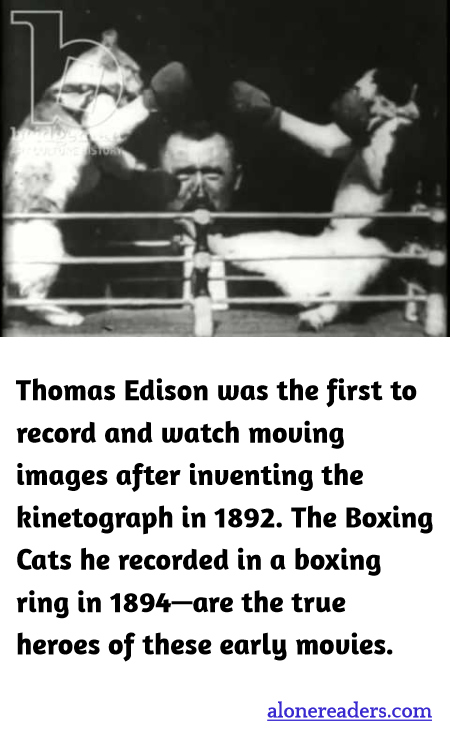
Thomas Edison, a name synonymous with invention and innovation, forever changed the entertainment world when he introduced the kinetograph in 1892. This early motion picture camera was a groundbreaking device that allowed for the recording of moving images, a concept that captivated the imaginations of people around the world. Although Edison himself did not invent the film camera, his improvements vastly increased the practicality and quality of early films. Two years after the debut of the kinetograph, in 1894, Edison's company produced a film that would underscore the charm and allure of early cinema: "The Boxing Cats."
Set in a miniature boxing ring, "The Boxing Cats" featured a pair of domestic cats, donned in boxing gloves, playfully sparring under the supervision of a referee. This short film, only a few seconds long, was more than just a whimsical portrayal of feline agility. It was a demonstration of Edison's kinetograph in action and a sample of how motion pictures could capture and amplify real-life moments into engaging spectacles. As one of the earliest instances of filmed entertainment, it introduced the public to the potential of moving pictures, showcasing not only a technical achievement but also a creative form of storytelling.
Edison's films—among them, the playful "The Boxing Cats"—were initially shown in kinetoscope parlors, where individuals would view the films through a peephole viewer, one person at a time. This method was characteristic of the early days of film exhibition, before the advent of projectors that could broadcast images to larger audiences. These novelty shorts were immensely popular, drawing crowds eager to see the animated wonders facilitated by Edison's inventions.
While "The Boxing Cats" might not embody the emotional depth or narrative complexity that later films aspire to, its importance lies in its role as a catalyst for the film industry. By capturing such a quirky, engaging scene, Edison and his company highlighted the kinetograph's ability to preserve and share moments of humor and novelty. It exemplified how even the simplest scenes could captivate and entertain, paving the way for the development of cinema as a form of popular entertainment.
Indeed, though the film is just a brief glimpse into a playful skirmish between two cats, it represents a significant milestone in the evolution of visual media. Films like "The Boxing Cats" laid the groundwork for the burgeoning film industry, indicating that cinema would not only be a medium for storytelling but also a platform for showcasing the extraordinary, the novel, and the amusing. In this way, these early films were not just technological marvels but also cultural artifacts, illustrating the endless human fascination with visual storytelling and entertainment.
