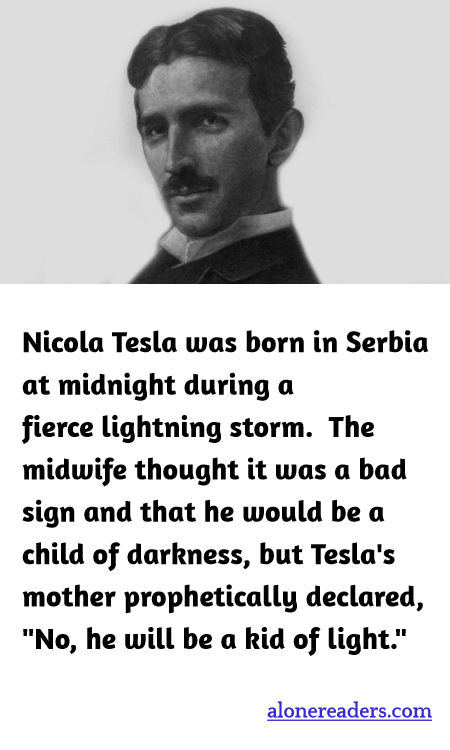
Born on July 10, 1856, in Smiljan, Serbia, now part of Croatia, Nikola Tesla's birth during a dramatic lightning storm would seem almost a premonition of his future feats. As the story goes, the midwife, amidst the tempestuous weather, deemed this unusual timing ominous, suggesting the newborn would be a "child of darkness." Yet, Tesla's mother, Djuka Mandic, a clever and inventive woman herself, immediately countered this foreboding assertion, insisting instead that he would be a "child of light." This anecdote, whether mythologized over the years or not, paints an evocative picture of Tesla's destined juxtaposition against nature and technology.
Tesla grew up in an era brimming with scientific curiosity and was himself an embodiment of the intellectual ferment of the time. Educated at the Technical University at Graz, Austria, and the University of Prague, he was well-versed in physics and electrical engineering. Tesla's early career was marked by a stint at the Continental Edison Company in Paris, where he gained practical experience in electrical engineering.
The most transformative period of his career began after his immigration to the United States in 1884, where he briefly worked with Thomas Edison before venturing out on his own. The differences in vision between Tesla and Edison, particularly over the superiority of alternating current (AC) versus direct current (DC), would lead to a storied conflict known as the "War of the Currents." Tesla's advocacy for AC, which he believed was more efficient and safe for long-distance electricity transmission, ultimately proved successful.
Tesla's contributions to electromagnetism and engineering are monumental. Among his numerous inventions and developments, the induction motor, the Tesla coil, and contributions to radio technology are perhaps the most renowned. His idea of wireless communication and energy transfer was far ahead of its time. Although many of his grander visions, such as wireless global energy networks, were never fully realized in his lifetime, they have inspired generations of engineers and scientists.
A figure shrouded in both brilliance and mystery, Tesla died on January 7, 1943, in New York City. His life was one of both celebrated achievements and profound challenges. Despite struggling with financial issues and receiving recognition that oscillated over the years, Tesla's legacy in the realms of science and technology is foundational. The "kid of light," as prophesied by his mother, not only illuminated the world with his innovations but continues to inspire the pursuit of scientific knowledge and exploration of the unknown.
