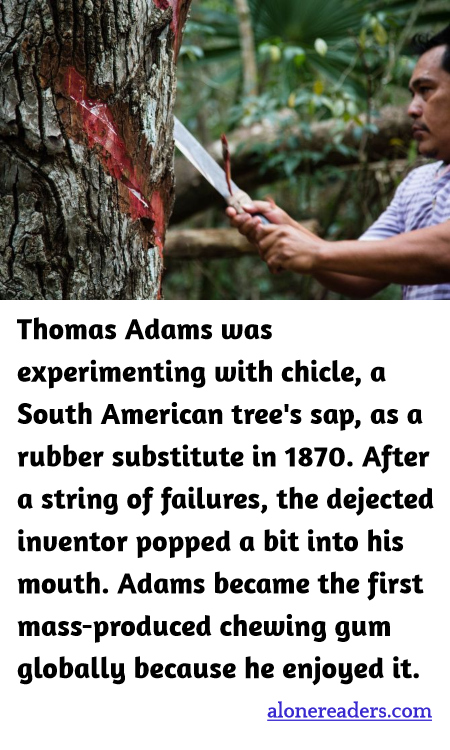
In the late 19th century, Thomas Adams embarked on a series of experiments that would inadvertently lead to the creation of one of the world’s most popular confections: chewing gum. Adams, originally focused on finding a substitute for rubber, directed his attention to chicle, a natural sap derived from the sapodilla tree native to Central America. His intention was to utilize this sap in industrial applications, perhaps to create tires, rain boots, or other rubber goods.
Initially, Adams's efforts met with little success. Frustrated and seeking a moment of respite, he did something unexpected—he put a piece of chicle into his mouth. To his surprise, he found the texture appealing and the experience of chewing it enjoyable. This serendipitous act shifted Adams’s focus from industrial applications to the potential of chicle as a base for a chewing gum.
Seeing an opportunity, Adams began to refine the chicle, adding flavors and sweeteners to make it more palatable. His experiments soon paid off, leading to the creation of the first flavored chicle-based chewing gums, which he began to mass-produce. This marked the birth of the modern chewing gum industry. Adams’ product quickly caught on, and by the late 1880s, "Adams New York Chewing Gum" was being sold in drugstores across the United States.
Adams did more than simply invent a new snack; he catalyzed a global industry that would expand to include countless brands and varieties of gum. Beyond just a treat, gum was used by the American military as a morale booster and is currently used by many as a means to aid concentration, freshen breath, and reduce hunger.
From a failed attempt at industrial innovation to the accidental discovery of a beloved treat, Thomas Adams’s story is a perfect example of how unexpected twists can lead to joyful discoveries. It serves as a testament to the idea that sometimes, the best inventions are stumbled upon entirely by accident.
