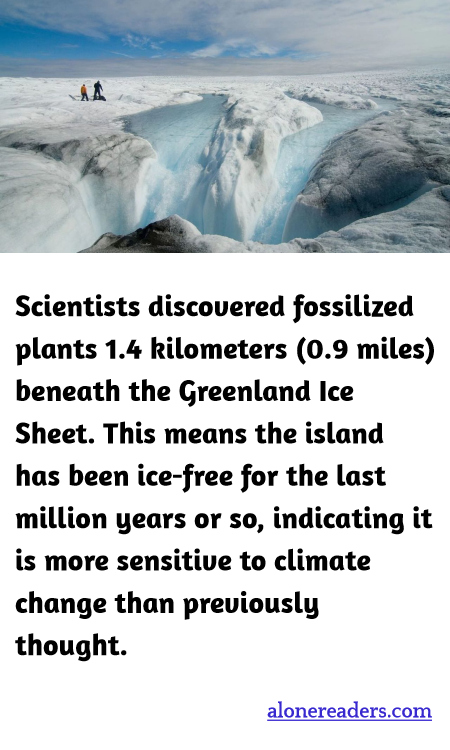
The recent discovery of fossilized plants deep beneath the Greenland Ice Sheet has provided groundbreaking insights into the island's geological past and its vulnerability to climate change. Located 1.4 kilometers (0.9 miles) below the ice surface, these ancient plant remnants suggest that Greenland has undergone significant ice-free periods within the last million years, challenging previous understandings of its climatic stability.
This revelation is crucial because it implies a greater sensitivity to climatic shifts than scientists had previously calculated. The traditional view held Greenland's ice sheet as a relatively stable, enduring feature over millions of years. However, the presence of these fossils indicates that the ice has completely melted and reformed over geologically short periods, influenced by changes in global temperatures and possibly atmospheric compositions.
The implications of this discovery extend far beyond academic interest. If Greenland's ice sheet has historically been so reactive to shifts in climate, the current trends in global warming could have more profound and rapid impacts on its ice coverage than anticipated. This is especially significant given the role of the Greenland Ice Sheet in contributing to global sea-level rise. As it melts, it adds freshwater to the oceans, raising sea levels and potentially altering global ocean currents and weather patterns.
Moreover, this find aids in refining the models used by climatologists to predict future climate scenarios. With more accurate data on how Greenland's ice has responded to past temperature fluctuations, scientists can improve the predictions on how much ice might be lost in coming decades, and the subsequent effects on sea levels.
In essence, the discovery of these fossilized plants beneath the Greenland Ice Sheet serves as a crucial reminder of the dynamic and sensitive nature of Earth's climatic system. It underscores the urgent need for robust, effective strategies to mitigate climate change and adapt to its inevitable impacts. As researchers continue to decode the secrets held within the ice, each finding adds a piece to the puzzle of Earth's climatic history, providing valuable lessons for both the present and future environmental strategies.
