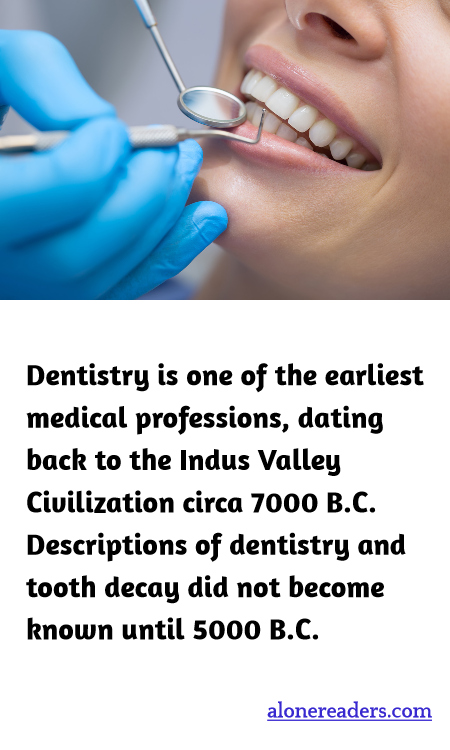
Dentistry, as a recognized professional discipline, has a history that dates back thousands of years to the Indus Valley Civilization around 7000 B.C. Evidence from this period indicates that people from this ancient culture were practicing forms of tooth drilling using rudimentary tools crafted from flint. These early dental practices, surprisingly sophisticated for their time, suggest a rudimentary understanding of oral care that predates written history.
The journey from these ancient beginnings to modern dentistry has been long and evolutionary. In 5000 B.C., descriptions of dental practices and tooth decay began to appear in written form. Historical Sumerian texts from this period mention "tooth worms" as the cause of dental decay, a belief that endured until the 18th century. This ancient misunderstanding underscores the primitive level of medical knowledge regarding dental health in these early times.
As civilizations advanced, so did their understanding and techniques in dentistry. By 2600 B.C., the Egyptians had begun to establish the role of the "dentist." Hesy-Re, an Egyptian scribe, often recognized as the first dentist, had an inscription on his tomb that declared him the "greatest of those who deal with teeth, and of physicians." This points to a societal acknowledgment of dentistry as a distinct profession.
Greek and Roman writings also contributed significantly to dental knowledge. Hippocrates and Aristotle wrote about dentistry, specifically about treating decayed teeth and gum disease, extracting teeth, and using wires to stabilize loose teeth and fractured jaws. In Rome, medical authors like Celsus described oral hygiene practices such as the use of toothpicks, massaging gums and teeth, and the use of abrasives to clean teeth.
The Middle Ages saw further advancements, although most dental care was provided by barbers who performed a wide variety of services including surgery, bloodletting, and tooth extraction. During this time, the understanding of mouth anatomy became more detailed, paving the way for more sophisticated dental treatments.
The Renaissance ushered in a more scientific approach to medicine, including dentistry. The 18th century, in particular, saw significant advancements thanks to French surgeon Pierre Fauchard, known as the father of modern dentistry. He released his seminal book, "The Surgeon Dentist, A Treatise on Teeth," which for the first time defined a comprehensive system for the practice of dentistry, including oral anatomy, operative methods, and denture construction.
Today, dentistry has evolved into a complex field with numerous specializations, including orthodontics, periodontics, endodontics, and cosmetic dentistry, among others. Modern technology, such as digital X-rays, lasers, and computer-generated imaging, plays a critical role in enhancing diagnostic precision and treatment. The progression from primitive flint tools to today's high-tech instruments highlights a remarkable journey not just of dental practices but of our understanding of human health and physiology.
