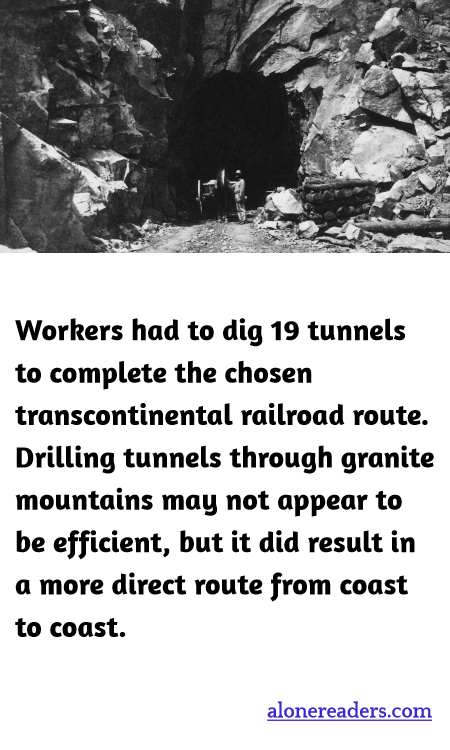
Building a transcontinental railroad was an enormous engineering challenge that required not only ingenuity but also a considerable amount of determination and hard labor. In particular, the decision to drill 19 tunnels through mountains of solid granite stands out as a monumental achievement of 19th-century engineering. While at first glance, tunneling through such hard rock may seem an inefficient route, the outcome justified this bold approach.
The primary goal was to establish the most direct and practical route across the continent. Direct routes are generally shorter, which reduces travel and transportation time significantly. This is crucial for a railway system, which aims to provide the most efficient service for freight and passengers alike. Mountain ranges, with their formidable natural barriers, posed significant challenges. Avoiding them entirely would often require much longer tracks circumnavigating the natural obstructions. Thus, tunneling through the mountains, despite being labor-intensive and time-consuming, was a strategic choice to maintain a direct, efficient path.
The engineering task was gargantuan. The workers, many of whom were immigrants facing harsh working conditions, had to use explosives and early pneumatic drills to slowly carve through the granite. The danger of this phase of construction was immense, with risks from falling rocks, explosions and the very real danger of collapses. It required precise calculations from engineers and incredible bravery from laborers.
Despite these challenges, the completion of these tunnels was a testament to human resolve and technological progress. The benefits of choosing such a direct route were numerous. It facilitated a boom in economic activity, allowing for the faster movement of goods across the country which lowered the cost of goods and increased profit margins. It connected distant communities, fostering a greater sense of unity across the United States. The railway also had a profound effect on the American landscape itself, opening up new areas to settlement and development.
In conclusion, while the decision to drill through granite mountains to construct railroad tunnels might not have seemed efficient initially, in the long run, it proved to be a wise strategic choice. By choosing this path, the engineers of the transcontinental railroad overcame natural geographic barriers to create a faster, more efficient way to move across the country, thus propelling the nation into a new era of growth and connectivity.
