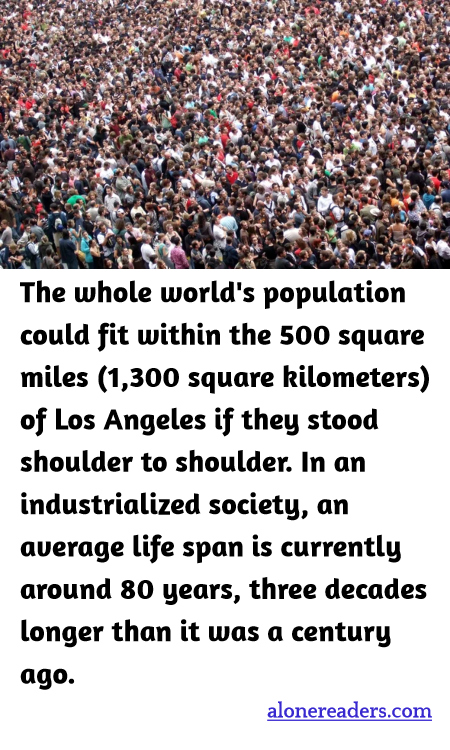
The concept that the entire human population could fit into the area of Los Angeles, standing shoulder to shoulder, within just 500 square miles, is a startling illustration of density and space. This scenario underscores the vast potential of human organization and urban planning, but also highlights pressing issues like overpopulation and limited resources. The visual of billions of people condensed into such a compact area prompts reflection on our impact on the planet and the importance of sustainable living practices.
Meanwhile, the significant increase in average life spans in industrialized societies over the past century is a testament to the remarkable advancements in healthcare, nutrition, and technology. In the early 20th century, global life expectancy was significantly lower, with averages hovering around 50 years. Today, it stands at approximately 80 years in developed countries, primarily due to reductions in infant mortality, improvements in sanitation, and breakthroughs in medical science, including vaccinations and antibiotics.
Both of these facts, while on the surface drastically different, are deeply interconnected. The ability of a population to live longer and healthier lives has direct consequences on global demographics, urban density, and resource allocation. As life expectancy increases, the need for sustainable development becomes more urgent. Cities around the world continue to swell, challenging urban planners and policymakers to devise solutions that accommodate growing populations in environmentally sustainable and human-friendly ways.
This intersection of demographic density and longevity also invites a broader discussion on quality of life, illustrating that thriving in the modern world requires not just managing spatial constraints but also extending the benefits of scientific progress to all. As society continues to evolve, the challenge lies in balancing these scales responsibly, ensuring that while we might be able to fit into tighter spaces physically, our environmental, social, and health policies must also adapt to ensure a livable world for generations to come.
