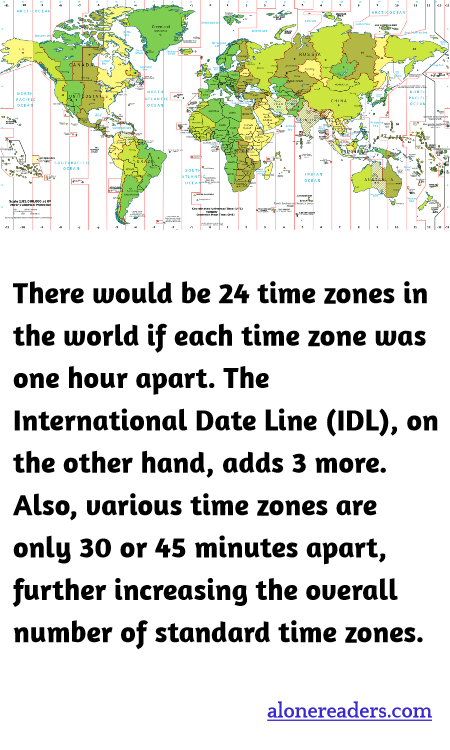
The division of the world into time zones is an essential aspect of modern-time keeping, enabling us to synchronize clocks across international borders. While it might seem straightforward that there should be 24 time zones globally, each representing a one-hour difference as the Earth rotates, the situation is more complex due to the International Date Line (IDL) and various fractional time zones.
Typically, the Earth is divided into time zones of one-hour intervals, each spanning 15 degrees of longitude. However, the IDL, which lies approximately along the 180th meridian, introduces additional complexity. It acts as a "line of demarcation" dividing two consecutive calendar dates. When crossing the IDL from east to west, one gains a day; crossing from west to east, one loses a day. This adjustment results in a need for not just 24, but rather 27 time zones including the time differences created by the IDL.
Moreover, the one-hour interval standard for time zones is not universally applied. Several countries and regions use time zones offset from neighboring zones by 30 or 45 minutes. For instance, India operates on Indian Standard Time (IST), which is UTC+5:30, diverging from the neighboring time zones by half an hour. Similarly, some places like Nepal and parts of Australia use a 45-minute offset, creating additional unique time zones.
This intricacy allows for greater precision and utility in daily life, aligning local time more closely with the solar day, an important factor for agricultural and social habits. Hence, the actual number of time zones worldwide exceeds the expected 24, illustrating the fascinating interplay between geopolitical decisions and natural timekeeping. This multitude of time zones, while complex, facilitates global interaction, ensuring that timekeeping meets local needs while enabling efficient international coordination.
