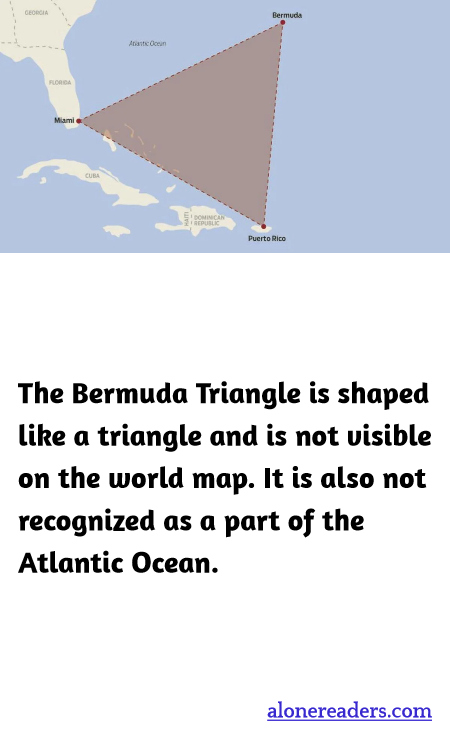
The Bermuda Triangle, also known as the Devil's Triangle, is one of the most intriguing mysteries in maritime history. Despite popular belief, the Bermuda Triangle isn't an official area and does not appear as a separate region on global maps. It is indeed a part of the Atlantic Ocean, contrary to myths that suggest otherwise. The triangle is roughly bounded by Miami, Bermuda, and Puerto Rico, covering an area of about 500,000 square miles.
The lore surrounding the Bermuda Triangle began to accumulate in the mid-20th century, largely due to a series of unexplained disappearances of ships and aircraft. The most famous of these include the disappearance of Flight 19, a group of five U.S. torpedo bombers on a training flight in 1945, and the civilian aircraft Star Tiger and Star Ariel in 1948 and 1949, respectively. What makes these disappearances intriguing and contributes to the mystery is the often quoted phrase that they happened “without a trace”. Reports often suggest that weather conditions were not particularly harsh and no wreckage was initially found, leading to a variety of speculative explanations.
Over the years, a number of theories have been proposed to explain the phenomenon observed in the Bermuda Triangle. Some of the explanations are based on environmental factors. For instance, the area is one of the few places on Earth where true north and magnetic north align, which could potentially confuse navigational instruments. The region is also known for its sudden, severe weather patterns and the presence of deep underwater trenches, which can create navigational challenges and unusual oceanic features.
Other theories stray into the realm of the more fantastical, including suggestions of paranormal or extraterrestrial activities. Despite these myriad theories, many scientists and researchers argue that the incidents within the Bermuda Triangle do not significantly exceed those of other parts of the ocean. The U.S. Coast Guard, for example, contends that the number and nature of incidents are similar to other parts of the Atlantic Ocean and that the supposed mysteries have been exaggerated.
In conclusion, while the Bermuda Triangle does capture the imagination with its mysterious allure, much of the fear surrounding it may be attributed to a combination of natural oceanic and atmospheric conditions, human error, and a tendency towards myth-making. Whether one views the region with a skeptical lens or embraces the enigma, it continues to be a topic of fascination and debate, emblematic of the enduring appeal of maritime mysteries.
