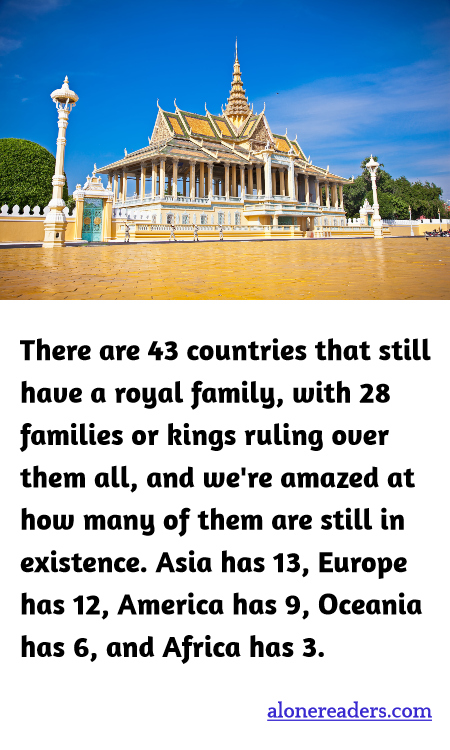
In an era dominated by modern republics and democracies, the existence of royal families might seem like a vestige from another age. Yet, 43 countries around the world maintain royal families, with a total of 28 reigning monarchs. These monarchs vary widely in their powers and duties, from purely ceremonial to significantly influential in their respective political systems.
Asia leads with the highest number of royal families, hosting 13 of them. These range from the globally influential House of Saud in Saudi Arabia to the constitutional monarchy of Japan, headed by Emperor Naruhito. In contrast, Europe, with its deep historical ties to monarchy, claims 12 royal families, including the widely recognized British Royal Family under King Charles III and smaller principalities like Monaco.
The Americas, though predominantly republics, are home to 9 royal entities, largely due to the political structures of the Caribbean islands. For example, several such as the Bahamas and Jamaica, acknowledge the monarchy of the United Kingdom, while others have local monarchs.
Oceania features 6 royal families, with the most prominent being the Royal Family of New Zealand, which also pertains to the other Commonwealth realms in the region like Australia, Tuvalu, and Papua New Guinea. Each of these nations recognizes the monarchy of the United Kingdom but maintains its distinct governmental system and independence.
Africa, with its rich tapestry of history and culture, has 3 countries with reigning royal families. These include the Kingdoms of Morocco and Eswatini, where the monarchs play significant roles in the political landscape.
The endurance of these royal families in the modern world can be attributed to a variety of factors. In some nations, they embody tradition and continuity, serving as a unifying symbol above the fray of political conflicts. In others, they attract tourists, fascinated by pomp and circumstance that represents a living history. Economically, monarchies like those in the Gulf States wield considerable influence over global oil markets, thus maintaining their relevance.
Despite the shifting sands of politics and power, the fact that nearly one-tenth of the world’s countries still uphold monarchies speaks to the lasting allure and intrigue of royalty. Whether as cultural figureheads, political influencers, or symbols of national identity, these royal families continue to play unique roles in the modern governance and cultural landscape of their countries.
