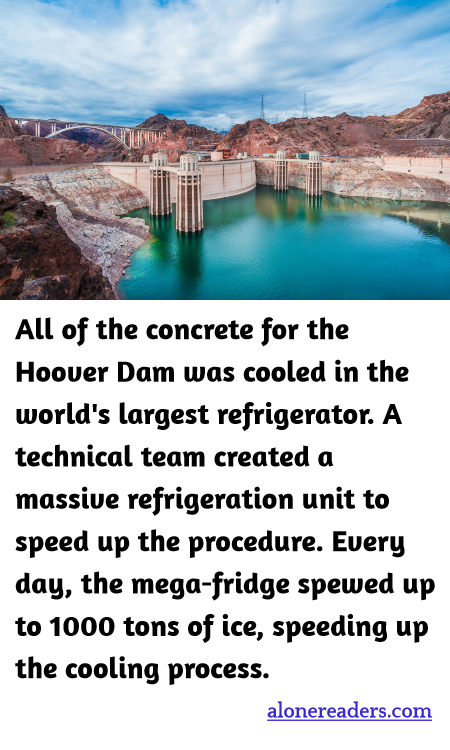
When constructing the colossal Hoover Dam in the 1930s, engineers faced an unprecedented challenge of not only building one of the largest dams in the world but also managing the heat generated by the curing concrete. Typically, concrete cures and hardens through a chemical reaction that releases a significant amount of heat. Given the immense volume of concrete used in the dam – over 3.25 million cubic yards – the heat released during curing could have caused the concrete to crack, compromising the structural integrity and longevity of the dam.
In a groundbreaking approach to solve this problem, the construction team incorporated a massive refrigeration plant on site, which at the time was the largest of its kind in the world. The requirement was not just about cooling the concrete but doing so uniformly and as quickly as possible to facilitate the continued construction above. This innovative system was designed to speed up the cooling process, thereby allowing quicker curing of the concrete.
The refrigeration plant employed up to 1,000 tons of ice daily and had the capacity to circulate chilled water through coils embedded within the concrete. This gargantuan "mega-fridge" played a crucial role in maintaining the concrete at a safe temperature, speeding up the cooling process and effectively reducing the time it took for the concrete to cure. Through this method, the potential for thermal cracking was significantly reduced, ensuring the durability and structural integrity of the dam.
The use of this refrigeration technology was a marvel of engineering foresight and innovation, highlighting the lengths to which the construction team went to ensure the success of one of the most ambitious infrastructure projects of the era. This method not only safeguarded the dam during its crucial early days but also demonstrated a novel approach to large-scale concrete construction, influences of which can be seen in modern construction projects that involve massive volumes of concrete. The Hoover Dam remains a testament to human ingenuity and the relentless pursuit of engineering excellence.
