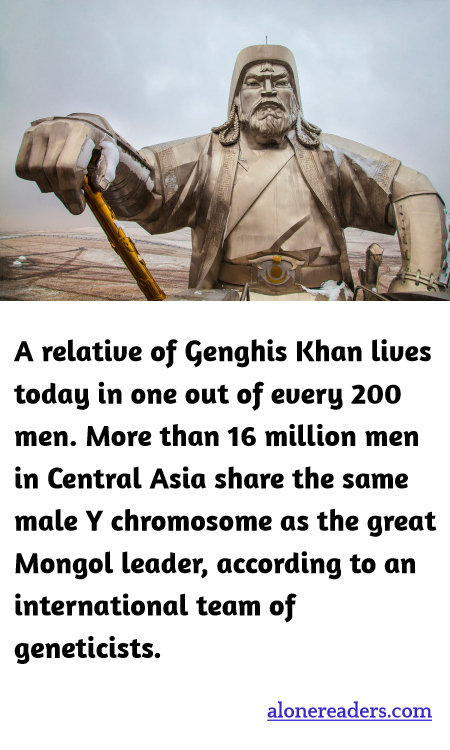
The genetic legacy of Genghis Khan, the formidable Mongol leader who established the largest contiguous empire in history, is remarkable not only in historical and cultural contexts but also in genetic terms. An intriguing study by an international team of geneticists has discovered that approximately one out of every 200 men today shares the same Y chromosome as Genghis Khan. This translates to more than 16 million men in Central Asia alone, a testament to the vast genetic impact he had during his reign in the 13th century.
This widespread genetic marker among men in modern populations can be attributed to the social and cultural practices during Khan's empire, which stretched from the Sea of Japan to the Caspian Sea at its peak. Genghis Khan's policies and the social structure of the Mongol Empire facilitated the spread of his genetic lineage. The Mongols, under Khan's leadership, established a vast network of trade and communication, often referred to as the Pax Mongolica. This period of relative peace and stability across the empire allowed for increased interaction among diverse populations across Asia and even parts of Europe.
The leadership style and practices of the Mongol Empire also played a crucial role. As Genghis Khan conquered vast territories, he and his descendants integrated into local populations, often through arranged marriages intended to solidify alliances and claim legitimacy over new territories. These strategic marriages further dispersed his genetic material across a vast region, thereby imprinting his genetic signature on generations to come.
The presence of this Y chromosome so many centuries later underscores the profound and long-lasting genetic imprint a single influential leader can have on human populations. This discovery has not only provided a fascinating insight into the genealogical footprint of one of the world's most legendary conquerors but also highlighted the complex interplay of genetics, history, and culture. As researchers continue to unravel human genetic history, findings such as these enrich our understanding of how historical figures continue to influence present-day human genetic diversity. The story of Genghis Khan's genetic legacy serves as a powerful example of how genetics and history are intertwined, influencing the make-up of contemporary populations in ways that we are just beginning to understand.
