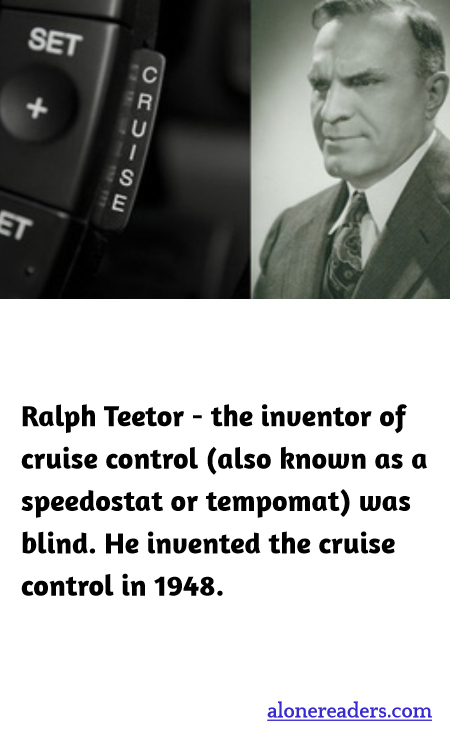
Ralph Teetor, a remarkable inventor who lost his sight at the age of five due to an accident, did not let his lack of vision hinder his ingenious capabilities. He is credited with the invention of cruise control, a system many drivers rely on today for maintaining a steady speed without constant foot pressure. Teetor's motivation stemmed from a personal experience during rides with his lawyer, who had a habit of slowing down while talking and speeding up while listening, making the journey rather jerky.
Teetor's invention, initially called the "Speedostat," was designed to provide a solution for maintaining a consistent speed, thereby enhancing comfort for both drivers and passengers. After years of development, Teetor received a patent for his device in 1950, and by 1958, the Chrysler Imperial became the first car to offer his "Auto-Pilot" feature, a marketing name for the speedostat or cruise control system.
The system works by taking control of the throttle of the car to maintain a steady speed as set by the driver, thus relieving the driver from constantly moving the foot on the accelerator pedal. This was particularly advantageous for long drives and has since become a standard feature in modern vehicles, with sophisticated adaptive systems that can automatically adjust speed based on traffic conditions.
Teetor’s legacy extends beyond just the convenience of cruise control. His invention highlighted how adaptive technologies can assist in reducing driver fatigue, improve fuel efficiency, and enhance the overall safety of automotive travel. His work is a testament to the impact of inclusive thinking in engineering, demonstrating that disabilities do not define one's ability to contribute significantly to technological advancements.
