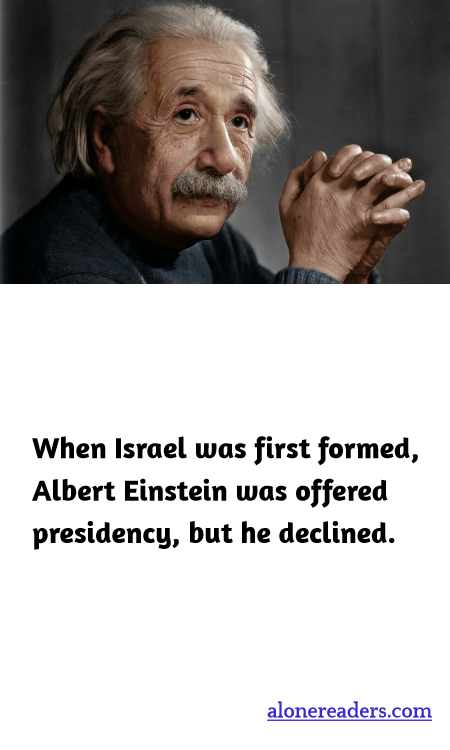
When Israel was established in 1948, it marked the beginning of a new era not just for the Jewish people but also for global politics. In the early days of its formation, the newly established state sought to solidify its global image and instill a sense of confidence both domestically and internationally. In this context, the choice of the country's first president was more than a ceremonial decision; it was a symbolic one, meant to resonate deep significance and embody the nascent state's ideals.
It is a less known fact that Albert Einstein, the world-renowned physicist and a prominent Jewish intellectual, was offered the presidency of Israel in 1952 following the death of Israel's first president, Chaim Weizmann. Einstein, born in Germany and by then an American citizen, epitomized not only extraordinary intellectual achievement but also a commitment to humanitarian and Jewish causes, as evident from his association with Zionist movements.
However, the proposition of Einstein becoming the president of Israel was met with his polite but firm refusal. His decline was rooted in several reasons that highlight his self-awareness and the respect he held for the nature of the position. Einstein explained that he lacked both the natural aptitude and the experience to deal effectively with people and to exercise official functions. Moreover, he voiced that his long-established personal mode of life would stand in stark contrast to the demands of such a high office, which required someone capable of handling the intense political responsibilities and diplomatic duties inherent to the role.
Einstein’s refusal was also influenced by his broader views on nationalism and state politics. Despite his support for Zionism and his deep compassion for the plight of the Jews, Einstein was fundamentally a man of science, dedicated to universal and transcendent ideals that often stood in sharp contrast to nationalist agendas. He saw his work and contributions to humanity as not confined to any single nationality or state.
The decision to offer the presidency to Einstein might have been symbolic, but his decline underscored a profound message: the importance of recognizing one’s own limitations and the responsibilities that come with public office. It also pointed to the universal respect commanded by Einstein, whose moral and intellectual authority reached far beyond the conventional corridors of power.
Despite his refusal, Einstein remained an iconic figure who continuously supported humanitarian projects and advocated for peace and civil rights until his death in 1955. His connection to Israel remained significant, symbolized by the Hebrew University of Jerusalem, which he helped establish and to which he bequeathed all of his papers. This act perhaps served as his own unique and lasting contribution to the state, aligning with his lifelong commitment to education and the free exchange of ideas.
