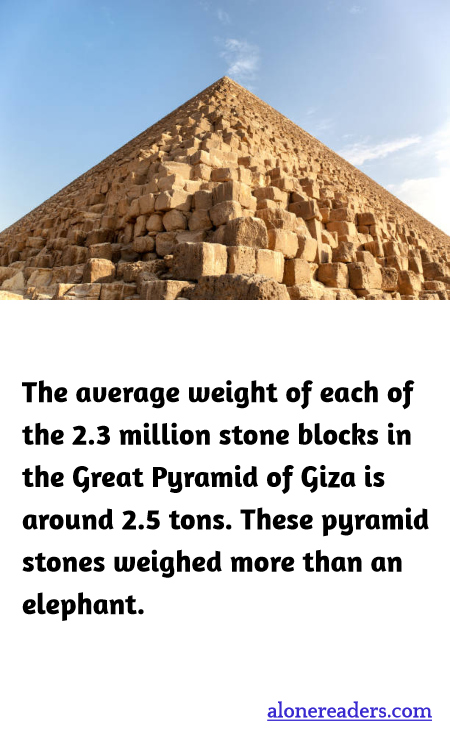
The Great Pyramid of Giza, one of the most astonishing and enduring monuments of ancient Egypt, was built over a 20-year period during the Fourth Dynasty for the Pharaoh Khufu. Constructed from approximately 2.3 million limestone and granite blocks, the sheer logistics of assembling the Great Pyramid remain a topic of debate and awe among historians and engineers alike. Each stone block used in the pyramid's construction weighs about 2.5 tons on average—surpassing the weight of an adult elephant, which can weigh up to 2 tons.
The massive weight of these blocks necessitated innovative engineering techniques, believed to have involved ramps and possibly wooden rollers. The workers, who were skilled laborers and not slaves as once thought, had to transport these heavy stones from quarries, with the nearest limestone quarry located just across the Nile. Some of the finer quality limestone used for the outer casing was transported from Tura, about 13 kilometers away, and the large granite stones used in the King's chamber were quarried from Aswan, located over 800 kilometers away.
The construction of the Great Pyramid was an impressive feat, not just because of the weight of the individual blocks but also due to the precision with which they were laid. The base of the pyramid covers over 13 acres, and its original height was 146.5 meters (480.6 feet), making it the tallest man-made structure in the world for over 3,800 years until the completion of Lincoln Cathedral in England in A.D. 1311. The alignment of the pyramid with the cardinal points and its astronomical precision further underscore the Egyptians' advanced understanding of mathematics and astronomy.
Today, the Great Pyramid stands as a testament to the ingenuity and skill of its builders and remains a source of fascination and inspiration. It is not only a symbol of the architectural and engineering prowess of ancient Egypt but also a reminder of the human spirit's capability to achieve the seemingly impossible.
