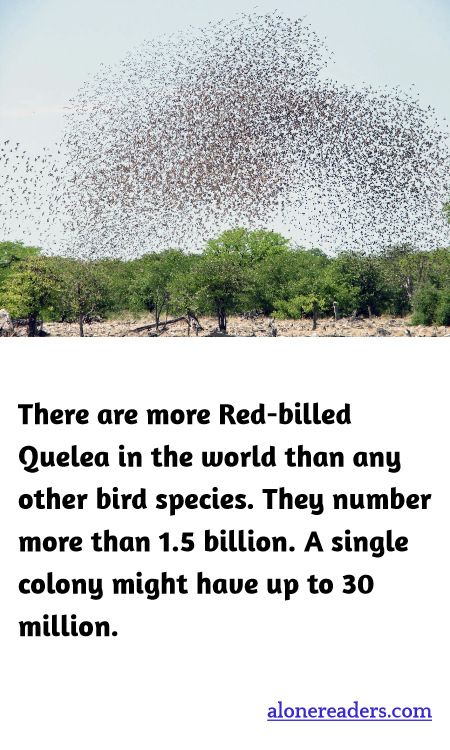
The Red-billed Quelea, a small bird prevalent across sub-Saharan Africa, holds the distinction of being the world's most abundant wild bird species, with populations estimated to surpass 1.5 billion individuals. Often described as Africa's feathered locust, the sheer number of these birds is so immense that a single colony can contain up to 30 million members, spanning across several kilometers when in flight and covering trees like leaves when they roost.
The Red-billed Quelea, with its distinctive red bill in males during the breeding season, primarily feeds on grains and seeds, making it infamous among farmers. Its feeding habits often lead to significant impacts on agriculture, sometimes devastating crops at locust-like speeds, which is why control measures are frequently enacted in areas heavily affected by their feeding flocks. Despite these measures, the species remains prolific, largely due to its high reproductive rate and the vast, variable landscapes of Africa that support their breeding and survival requirements.
The bird's ability to thrive in a variety of habitats has contributed to its massive population. They typically breed in semi-arid areas, where the availability of grass seeds post-rainfall provides ample food. Their breeding strategy is particularly flexible allowing them to breed up to three times a year under ideal conditions. Each breeding attempt can result in massive nesting colonies that collectively produce thousands of new birds, contributing to their explosive population growth and resilience.
Ecologically, the Red-billed Quelea represents both a challenge and a crucial component of its ecosystem. While their numbers can pose threats to crops and hence to the livelihoods of farmers, they also play significant roles in the food chain, serving as prey for various predators and contributing to the dispersal of seeds through their droppings, thus aiding in the ecological balance. As with many wildlife population management issues, the key lies in finding sustainable ways to coexist with these super-abundant birds, balancing agricultural needs with ecological and species preservation.
