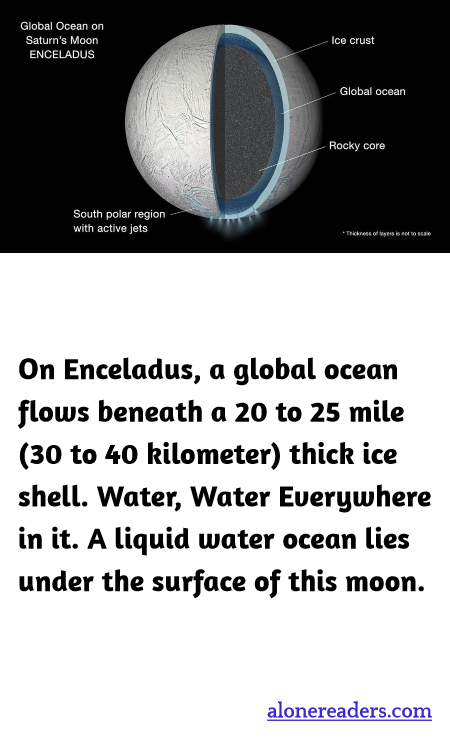
Enceladus, one of Saturn's icy moons, harbors a remarkable feature beneath its frozen exterior: a vast global ocean of liquid water. This subsurface ocean is concealed beneath an ice shell that is about 20 to 25 miles (30 to 40 kilometers) thick, presenting a fascinating domain for scientific exploration and the study of astrobiology. The discovery of this hidden ocean came from the observations of NASA's Cassini spacecraft, which conducted multiple flybys of Enceladus and gathered compelling data through its instruments, including ice-penetrating radar.
The presence of this ocean is particularly intriguing because it raises the possibility that Enceladus could support microbial life. The ocean is believed to be in direct contact with a rocky seabed, an environment where hydrothermal reactions may occur, potentially providing the chemical energy necessary to support life forms. During its mission, Cassini detected water vapor jets and icy particles being ejected from Enceladus' south polar region, where there are deep fissures in the ice shell known as "tiger stripes." Analysis of material ejected has revealed the presence of water vapor, ice particles, salts, and organic molecules, further enhancing the moon’s profile as a potential abode for life.
The implications of these findings are profound, not only in the quest to find life beyond Earth but also in understanding how celestial bodies can host environments favorable for life in extreme conditions. Enceladus has thus positioned itself as a critical target for future missions designed to search for extraterrestrial life. Scientists hope that further exploration will provide deeper insights into the ocean's composition and its potential for life, and perhaps even direct evidence of biosignatures in the water plumes that vent into space. Tools designed to detect and analyze these plumes could pave the way for breakthroughs in our understanding of life in the universe, turning Enceladus into a cornerstone of astrobiological studies. Meanwhile, the broader implications of these discoveries challenge our perceptions of where life can exist, both within our solar system and beyond, revealing the incredible diversity and adaptability of life's potential habitats.
