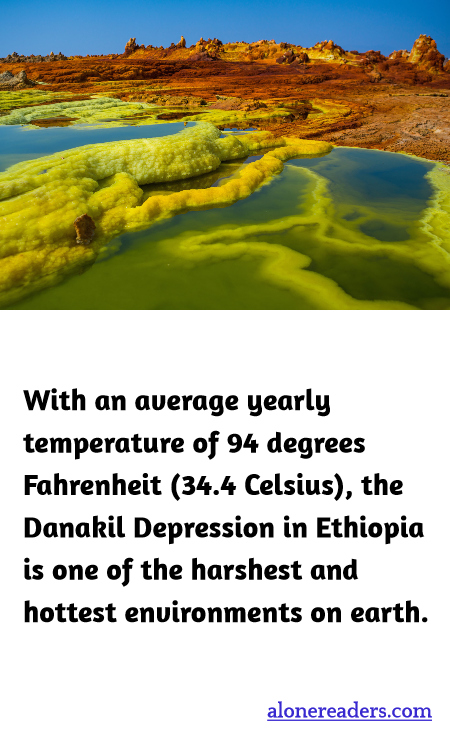
Situated in the Afar region of northeastern Ethiopia, the Danakil Depression is a marvel of geological extremes. This remote location, often described as "the cradle of humanity," is one of the hottest and most inhospitable places on the planet, with average yearly temperatures soaring to 94 degrees Fahrenheit (34.4 Celsius). It is a vast, sunken desert that stretches over 100,000 square kilometers, characterized by salt flats, volcanoes, geysers, and acidic hot springs.
The Danakil Depression lies at the junction of three tectonic plates, a rare geological feature that contributes to its unique and otherworldly landscape. The region's climate is not only hot but also dry, receiving less than 200 millimeters of rainfall per year, which quickly evaporates under the intense heat. Despite these harsh conditions, the Danakil Depression is home to various adaptations of life. Microbial communities thrive in its hot springs, and some hardy plant species can survive in its margins.
Historically, the local Afar people have navigated this extreme environment, harvesting salt from the massive salt pans where camel caravans travel, just as they have for centuries. This salt trade remains a vital part of their economy. The Depression is also rich in minerals and has recently become a site of interest for mining potassium and sulfur.
Tourists, attracted by its alien landscapes and the challenge of visiting one of the most extreme environments on Earth, often visit the Danakil Depression. Sites such as the Erta Ale volcano, an active shield volcano with one of the world's only persistent lava lakes, are particularly popular. However, tourism in such an extreme location comes with its risks, including the need for adequate hydration and protection against the severe heat.
The future of the Danakil Depression may see changes due to both natural geological processes and human activities. As tectonic plates continue to shift, new volcanic activity and landforms may arise. Meanwhile, the impacts of climate change and increasing economic interest in the area's minerals pose environmental concerns. These could alter the landscape and the way of life for the local Afar people.
In conclusion, the Danakil Depression presents a fascinating study of extremophilia in both the natural world and human culture. Its intensely hot, arid conditions push the limits of life and offer unique insights into Earth's geological activities and the resilience of ecosystems in the face of extreme heat and aridity. This remarkable region not only challenges the survival of its inhabitants but also attracts the curiosity and awe of the outside world, making it a unique intersection of natural wonder and human perseverance.
