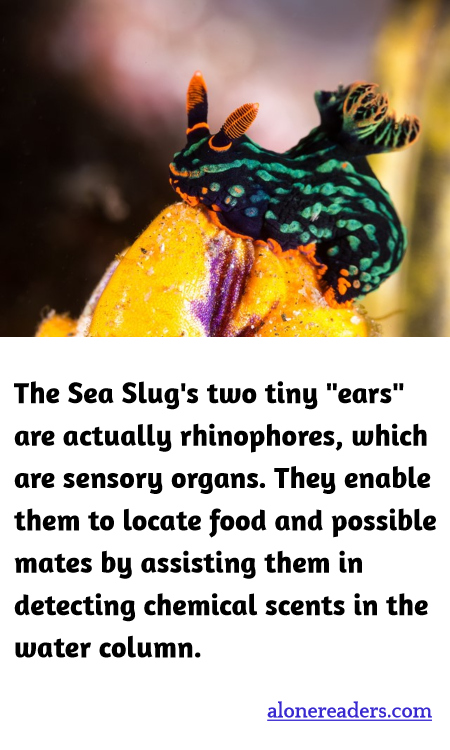
Sea slugs, those mesmerizingly vibrant creatures of the marine world, possess a unique feature known as "rhinophores", which might appear to be tiny ears at first glance. These are not auditory organs as one might instinctively think, but are crucial sensory tools that play a significant role in the survival and behavior of sea slugs. Rhinophores are located on the heads of sea slugs, and their primary function is to detect chemical signals in the aquatic environment, which is essential for finding food, navigating, and identifying potential mates.
The structure of rhinophores is specially adapted to maximize their sensitivity to the surrounding water chemistry. Each rhinophore typically resembles a stalk topped with either a feather-like or lamellar arrangement, which increases the surface area available to catch chemical particles dissolved in the water. This design allows sea slugs to detect even the faintest traces of scent, which could be indicative of nearby prey or the presence of another slug ready for mating.
Functionally, rhinophores are comparable to the olfactory system in mammals. Just as our noses pick up airborne scent molecules to identify smells, the rhinophores of sea slugs pick up on molecular cues drifting through the ocean. These cues can tell a sea slug a lot about its environment, enabling it to make crucial decisions that affect its survival and reproductive success. For instance, by detecting chemicals released by algae or other organisms they feed on, sea slugs can locate food sources even at a distance. Similarly, during mating seasons, rhinophores help them find partners by picking up specific chemical signals, often leading them to converge at common meeting points.
Moreover, the sensory ability of rhinophores becomes even more critical given the generally poor eyesight of most sea slugs. They can usually perceive light and dark and the most basic outlines of nearby objects, but little else. Thus, the chemical world revealed by rhinophores is their primary means of making sense of and navigating through their environments—a vital adaptation in the often vast and featureless marine habitats they occupy.
In essence, the rhinophores give sea slugs a profound edge in the underwater landscape, enhancing their interactions with both the living and non-living components of their ecosystem. With such specialized organs, these seemingly simple creatures are finely tuned to the dynamics of the marine world, demonstrating just how complex and intricately adapted marine life can be.
