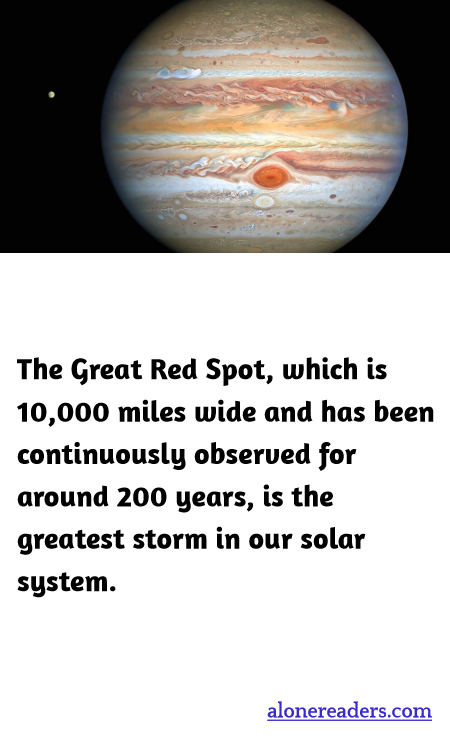
The Great Red Spot of Jupiter is not only a massive storm but also one of the most iconic features in our solar system. Spanning about 10,000 miles in width, it is large enough to accommodate Earth more than once. This colossal anticyclonic storm has been raging for centuries, with continuous observations dating back to about 1830, although some historical records suggest sightings as early as the 1660s.
Scientists believe that the storm has been persisting for at least 350 years. Its longevity and size are influenced by Jupiter's unique atmospheric conditions. The planet's atmosphere is primarily composed of hydrogen and helium, with trace amounts of water, ammonia, methane, and other elements. This composition, combined with the rapid rotation of Jupiter (which completes one rotation approximately every 10 hours), creates an extreme environment where storms like the Great Red Spot can thrive.
The reason the Great Red Spot has not dissipated like storms on Earth is partly due to the absence of a solid planetary surface on Jupiter. On Earth, hurricanes lose energy when they make landfall. However, Jupiter's gaseous composition allows the storm to maintain its vortex without being disrupted by any geographical features. Additionally, the storm's location in Jupiter's southern hemisphere seems to prevent it from migrating latitudinally, which keeps it stable and confines its energy.
Scientifically, the Great Red Spot is a treasure trove of information. Observations and studies of this gigantic storm help astronomers and scientists understand atmospheric dynamics not only on Jupiter but also in a broader context that can be applied to other planets and even exoplanetary systems. For instance, understanding how the storm has sustained itself for such a long period might offer insights into atmospheric processes on other gas giants in distant solar systems.
In terms of visibility, the Great Red Spot is often visible through small telescopes from Earth. For professional astronomers, spacecraft missions like Voyager, Galileo, and the recent Juno mission have provided close-up observations and detailed data. These missions have revealed intricate details about the storm's structure, dynamics, and even hints about its depth and the mysteries beneath the Jovian cloud tops.
As we continue to study this magnificent marvel, it stands not only as a witness to the longevity of celestial phenomena but also as a symbol of the dynamic and ever-evolving nature of the universe. The Great Red Spot remains one of the most studied phenomena in our solar system and continues to captivate both scientists and space enthusiasts alike.
