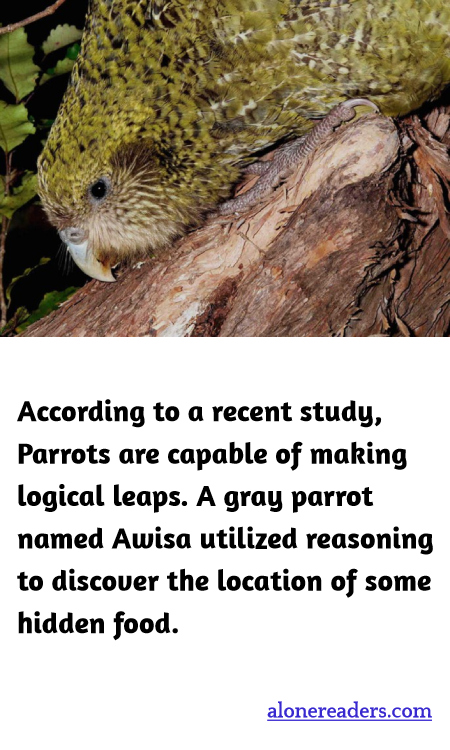
Parrots, known for their vibrant feathers and vocal abilities, may have cognitive gifts that rival those of young children. A striking illustration of this intelligence comes from a study involving a gray parrot named Awisa, who demonstrated remarkable reasoning capabilities in a series of tests designed to locate hidden food.
In the experiment, researchers presented Awisa with the challenge of finding a treat hidden in one of several containers. The parrot observed as the treat was placed in a specific container, which was then shuffled among others. Not only did Awisa keep track of the treat's location through basic observation, but she also successfully inferred its location when only indirect information was available. For instance, in some tests, she deduced where the food was hidden by eliminating the other possible locations where it was shown not to be. This process of elimination requires understanding that if the treat is not in multiple other places, it must be in the remaining one. This kind of logical reasoning—often considered a complex cognitive skill—is impressively sophisticated for an animal.
The implications of Awisa's performance extend beyond the avian world, suggesting that the ability to reason and make logical leaps may not be as uniquely human as traditionally believed. Researchers speculate that such capabilities could be widespread in the animal kingdom, potentially altering our understanding of animal intelligence and cognition.
Moreover, these findings contribute to a growing body of evidence that parrots, particularly gray parrots, possess significant intellectual abilities, including the capacity for abstract thought, problem-solving, and perhaps even empathy. These capacities not only highlight the intellectual prowess of parrots but also emphasize the need for stimulating environments to nurture their complex minds.
As we continue to explore the cognitive landscapes of non-human species, studies like these not only widen our comprehension of animal intelligence but also challenge our own preconceptions about the limits of animal minds. They reframe our perspective, encouraging a deep respect and heightened responsibility toward these intelligent creatures and their conservation. The story of Awisa is not just an anecdote of animal intelligence but a beacon lighting the way to broader horizons in our understanding of the natural world.
