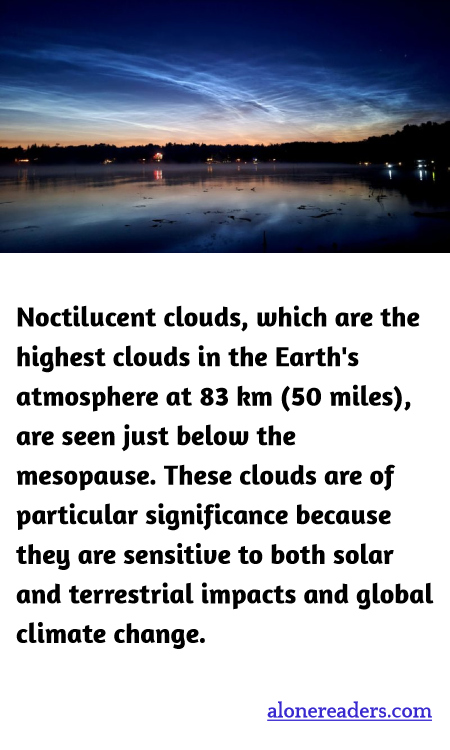
Noctilucent clouds, or night shining clouds, are a mesmerizing atmospheric phenomenon. Positioned at a staggering height of about 83 kilometers (50 miles) above the Earth, these clouds reside just below the mesopause, the coldest part of the Earth's atmosphere. Primarily observed during the summer months in the polar regions, these silvery-blue clouds get their luminescence from the sunlight reflecting off ice crystals in the cloud, often visible during twilight hours when the sun is below the horizon for observers on the ground.
The formation of noctilucent clouds is closely tied to the conditions of the mesosphere, where they originate. Scientists believe that these clouds form when water vapor rises to the upper reaches of the atmosphere and condenses on smoke or dust particles, creating ice crystals under the extremely low temperatures found at these altitudes. What makes noctilucent clouds particularly fascinating is their sensitivity to the dynamic changes of both the Earth’s climate and various solar influences. Their occurrence and variability are influenced by factors such as volcanic eruptions or changes in solar activity, which can alter the upper atmosphere's temperature and moisture content.
Increasingly, researchers are studying noctilucent clouds not just for their stunning natural beauty but also for what they can tell us about our planet. These clouds are like a sensitive gauge for the interactions between human activity, natural climatic shifts, and space weather. As indicators of atmospheric changes, observing the frequency, location, and appearance of noctilucent clouds can help scientists understand more about the processes occurring in the upper reaches of the atmosphere, including the impacts of global climate change.
Not only are noctilucent clouds important for scientific research, but they are also a captivating subject for astronomers and photographers. The ethereal quality of their light and the remote conditions required for their formation add an element of allure and mystery to their observation. As climate change continues to influence our planet's environmental conditions, noctilucent clouds may appear more frequently and at latitudes further away from the poles, providing both a beautiful visual spectacle and a poignant reminder of the changes occurring within our atmosphere. As scientists uncover more about these enchanting clouds, they will undoubtedly continue to fascinate and educate those looking up at the edges of space.
